
Threads
Measure Z Projects
Cupertino Union School DistrictCUSD Measure Z Approved with $347M Bond
Measure Z, a bond measure for Cupertino Union School District (CUSD), has been approved with a 61.07% approval rate. This bond, amounting to $347 million, will be funded through a property tax rate of approximately $21 per $100,000 of assessed valuation, generating $23,300,000 annually. Importantly, Measure Z extends the current tax rate without any increase.
Next Steps: Allocating the Funds
With the bond approved, it's now crucial to determine how to allocate the funds to maximize benefits for the community and the school district. A Citizens' Bond Oversight Committee will be formed, appointed by the school board, to ensure transparency and effective use of the bond money. For more information about Measure Z, please see here.
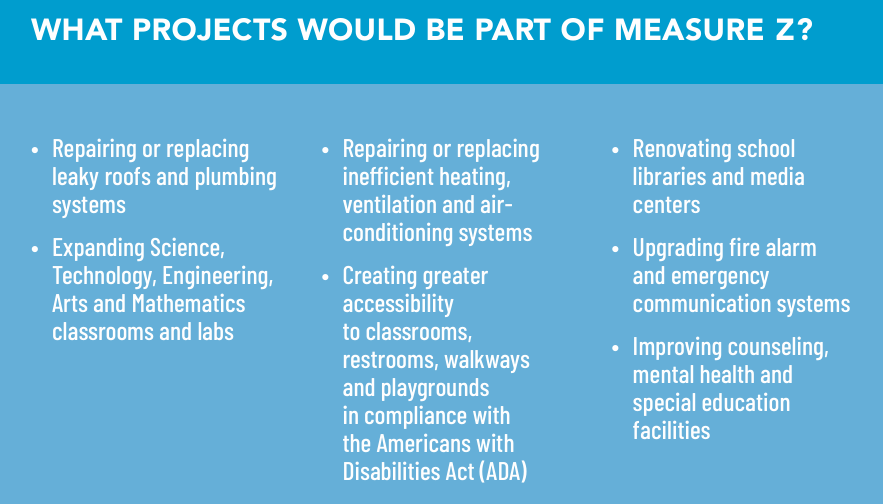
Partial Project List
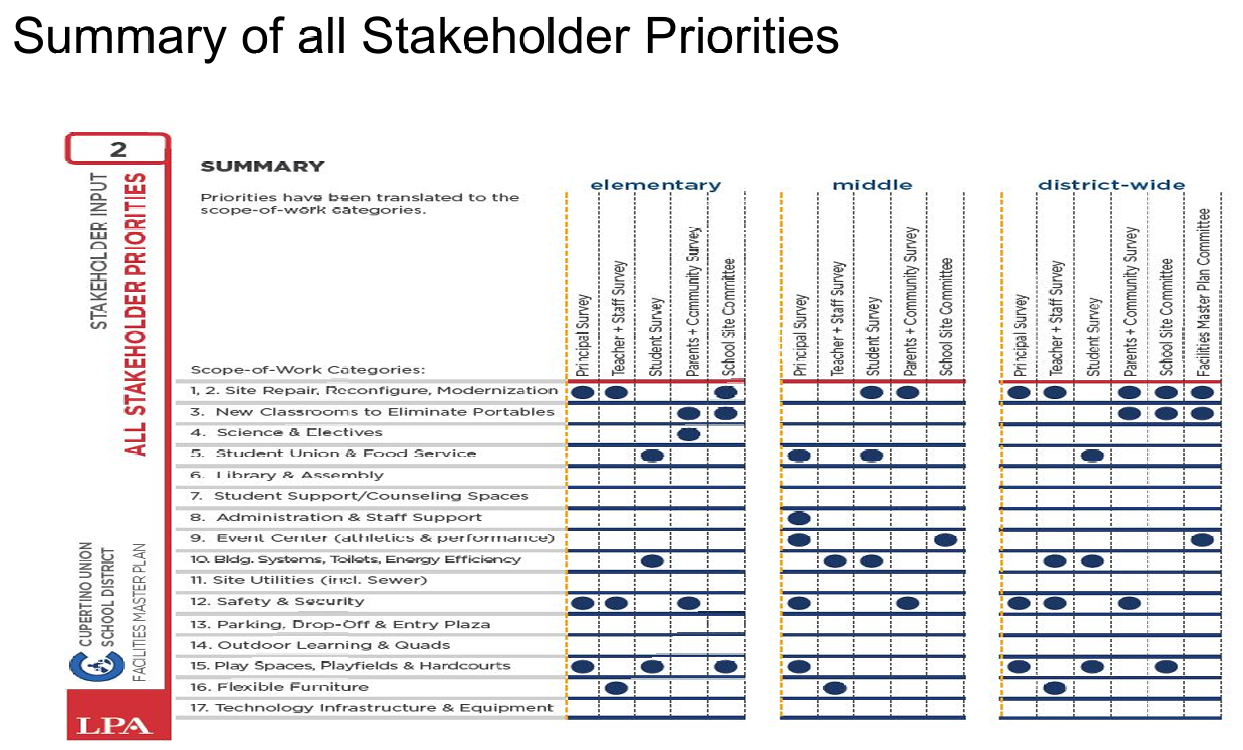
The district hired a third party conducted a survey about priorities of the projects.
Hiring Contractors for Measure Z Projects
There is a discussion on the best approach to hiring contractors. One perspective advocates for exclusively hiring unionized contractors to ensure better quality work and suggests using a Project Labor Agreement (PLA). According to sources, PLAs can have various impacts:
- Impact on Cost: PLAs may increase the overall cost of the projects
- Impact on Competition: PLAs could discourage or prevent non-unionized contractors from competing for construction projects.
- Impact on Minority Contractors: PLAs might disproportionately impact small businesses, particularly those owned by women and minorities.
- Local Impact: PLAs can be used by public project owners like school boards or city councils to set goals for creating local jobs and achieving social welfare goals.
This issue was visited at the Board Winter Advance on January 23, 2025..
Use Measure Z to Reimburse Previous Project?
There was a tentative resolution proposed at the board meeting on December 9, 2024. The tentative resolution stated, "the District will reimburse the District’s Building Fund 21 the balance of the debt lease financing for the District solar project costs from the bond proceeds from Measure Z".
The resolution was for discussion only and didn't appear at subsequent board meetings.
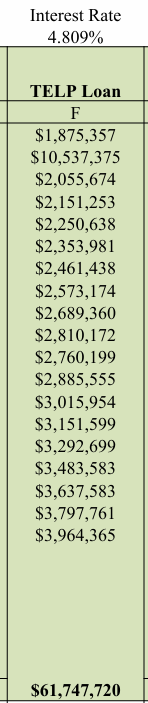
The solar project was approved on November 2, 2023. According to the presentation, the project is funded with a debt that can be paid off through savings on utility bills. The district starts to save money even with the debt in place. The debt is like a mortgage. If not paid off, the 19 year total payment would be more than $61M.
Pros and Cons of Using Measure Z to Pay Off the Solar Project Pros:
- The district won't need to pay for the solar debt in the future, which will reduce the expenditure from the general fund (about $1.8M per year).
Cons:
- It will impact the number of new projects Measure Z can support.
- The community may not anticipate or agree with this usage of funds.
How to Handle Controversial Issues in CUSD
Cupertino Union School DistrictSince the beginning of the 2024-25 school year, the Cupertino Union School District (CUSD) has faced several controversial issues, attracting significant media attention. You can find some media reports here and here.
Long Jiao mentioned adoption of BP 6144 at the Board Meeting on September 26, 2024, a request also made by a group of CUSD parents at CurriculumIntegrity.org. Board members Jerry Liu, Phyllis Vogal, Sylvia Leong, and Satheeth Madhathil requested to add BP 6144 to future agenda items during the September 24, 2024, board meeting.
BP 6144 appeared in the Board Advance on October 17, 2024, and will be revisited in the future.
BP 6144 is a board policy regarding instructions related to controversial issues.
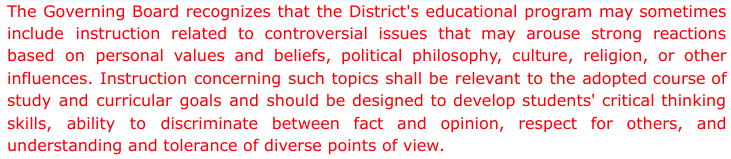
Some of the guidelines for instructions related to controversial issues are:
- The topic shall be age-appropriate.
- Instruction shall be presented in a balanced manner without bias and without promoting any particular point of view.
- In the classroom, teachers act on behalf of the District and are expected to follow the adopted curriculum, meaning they have limited freedom of speech in the classroom.
- Students have the freedom of speech without jeopardizing their grades or being subject to discrimination, retaliation, or discipline.
Below are the full list of guidelines.
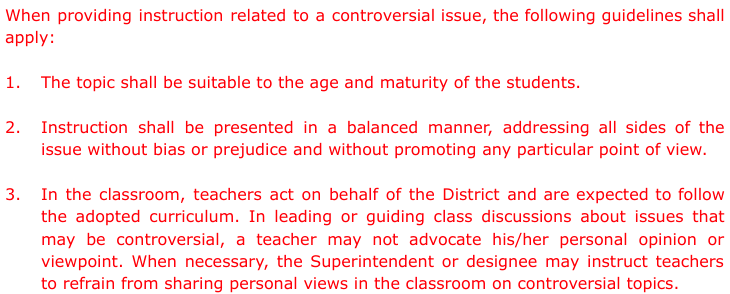
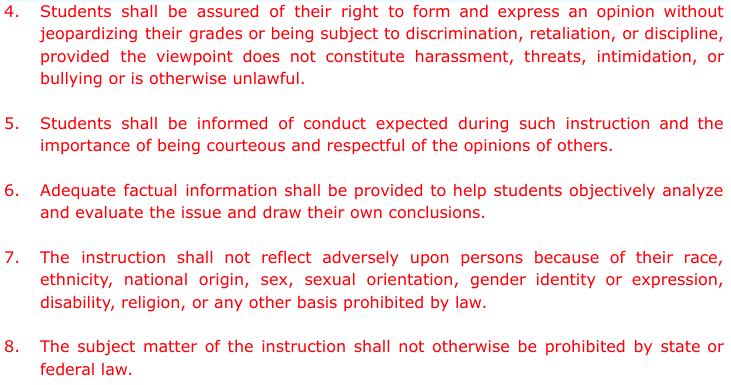
A group of CUSD parents supported BP 6144. And some members of the Cupertino Educators Association (CEA), or the Teachers' Union, opposed it.
BP 6144 has been adopted by numerous California school districts, including the Fremont Union High School District, which encompasses the entire CUSD area.
CUSD adopted BP 6144 at the board meeting on 11/21. See here and here for details.
CUSD School Closures in 2021
Cupertino Union School DistrictDuring the board meeting on 10/14/2021, CUSD Board voted (with 3:2 simple majority) to close Meryerholz and Regnart Elementary Schools. This decision had profound consequences to the community.
But this is not the end of it. According to the Board Meeting on 9/23/2021, the district might evaluate another possible school closure in FY2025-26.

It's important to revisit what happened in 2021 to understand the process and the reason leading to the schools' closure, as well as what can be improved.
The Timeline
CUSD failed to pass parcel tax Measure O in March 2020.
CUSD created a Citizen Advisory Committee (CAC) in the Spring of 2020 to consider options for school closures and consolidations.
The CAC presented the final report on 10/22/2020 after five meetings.
In November 2020, right after the election, the community was informed about possible school closures.
CUSD failed to pass another parcel tax Measure A in May 2021. According to [the report] (https://go.boarddocs.com/ca/cusdk8/Board.nsf/files/C78SEY0492B6/$file/Cupertino%20Union%20School%20District%20-%20Final%20Report.pdf), "The Parcel Tax revenue would allow the district to delay the decision of closing schools."
The district resumed school closure process after the failure of Measure A.
The board voted 3:2 to close Meyerholz and Regnart at the Board Meeting at 10/14/2021.
The Reason
The district mentioned two reasons for school closures:
- Declining enrollment
- State funding affecting the district budget
The district expected the enrollment to continue to drop.
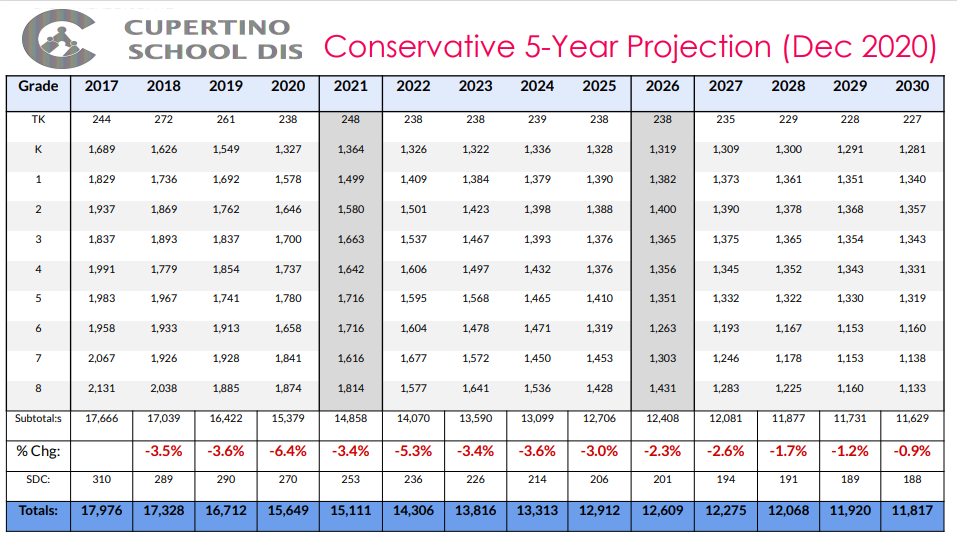
The district expected the budget to be in a deficit for many years.
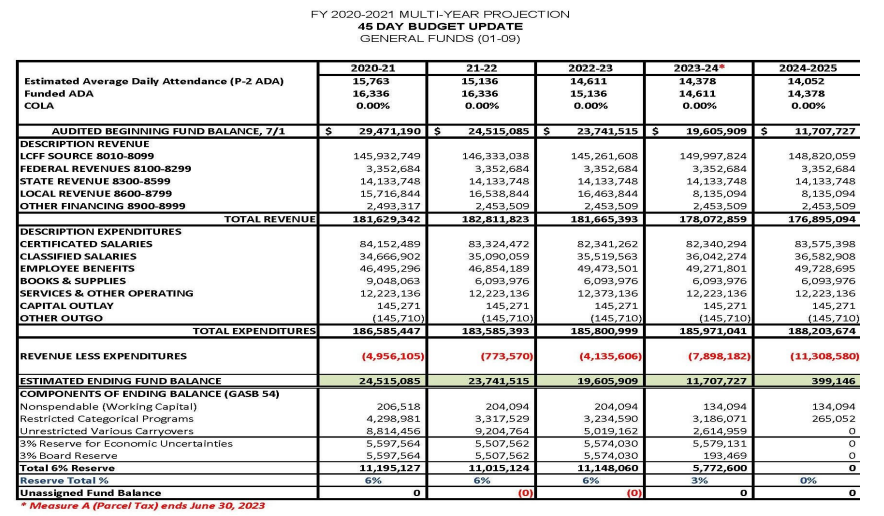
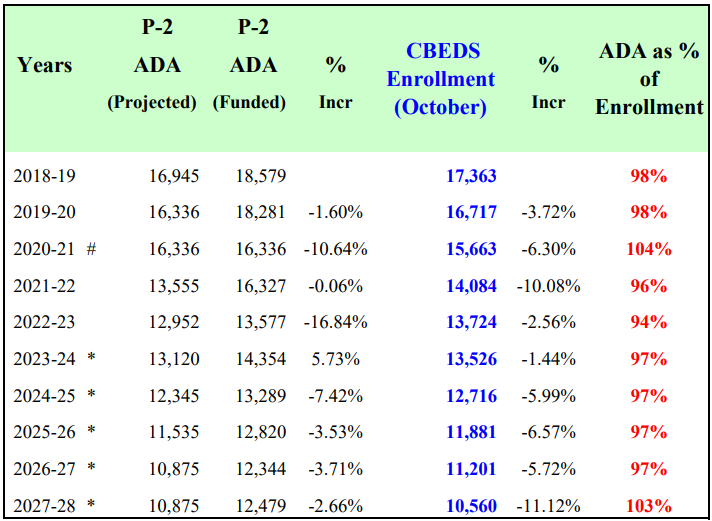
Several years have passed, and I collected the actual data and compared with the prediction below. The enrollment prediction was relatively accurate, but the financial predictions were way off.

Notably, the budget in FY 2023-24 is in a deficit again even though the actual revenue is $42M more than the predicted revenue and $34M more than the predicted expense.
One of the reasons for school closures was to reduce the expense, but the expense was not affected by the school closures at all.
Enrollment Rules The district proposed two enrollment rules during the school closures in 2021.
- Each elementary school should be staffed with at least two Kindergarten classes.
- Each middle school should be more than 700 students. (see above)

According to publicschoolreview.com, average school size in California is 588 students.
What Can Be Better?
Since the CUSD school closures in 2021, possible future school closures have become nightmares among local residents, such as the dispute related to the FUHSD Trustee Area transition.
To restore residents' confidence to the district, I think there are at least two things the district can improve on
- Critical district issues (like school closures, reconfiguration, selling school sites, etc,) should require super-majority (or 4 out of 5) votes from the board.
- If schools are going to be closed due to low enrollment, they need to have opportunity of open enrollment programs across the district.
Note
Someone asked for the voting record for the school closures. You can find the information from the record for the 10/14/2021 board meeting at Agenda - Cupertino Union School District BoardDocs® Plus. They don't have a direct link and you have to manually find the meeting on that day. It was agenda item 13.1. Below is a screenshot.
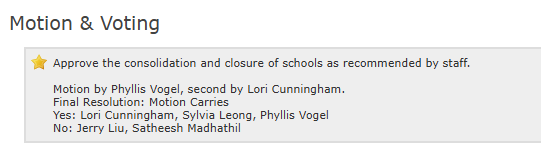
Please notice Sylvia Leong and Phyllis Vogel's current term end at the end of 2024. Sylvia is seeking for re-election while Phyllis hasn't pulled any paper yet (up to 7/25/2024).
CUSD New District Office
Cupertino Union School DistrictAt the Board meeting on 4/25/2024, the Board discussed the plan to relocate the District Administrative Office from its current location at S. Mary Avenue, Sunnyvale to the Meyerholz campus. which was closed by the district in 2021.
The district plans to use Certificates of Participation (COP) debt to finance the new office building. Unlike bonds, which need to be approved by voters, COP comes from the district's operating budget and doesn't need voter approval. The district is currently in a budget deficit.
Since CUSD is renting its current Administrative Office, after moving into the new office, the district needs to pay the COP, but not the current rent. The current rent is about $471K per year. The COP payment would be about $686K per year, an increase of about $215K per year. I assume the district would pay both current rent and the COP while the new office building is in construction. But the district needs to pay neither after COP is paid off (30 years later).
This district is planning to convert Meyerholz Elementary School to new district office, but is this the best location? I assume once Meyerholz is converted to district office, it wouldn't be suitable to be a school anymore. Should we keep Meyerholz as a potential school site and build the new district office somewhere else?
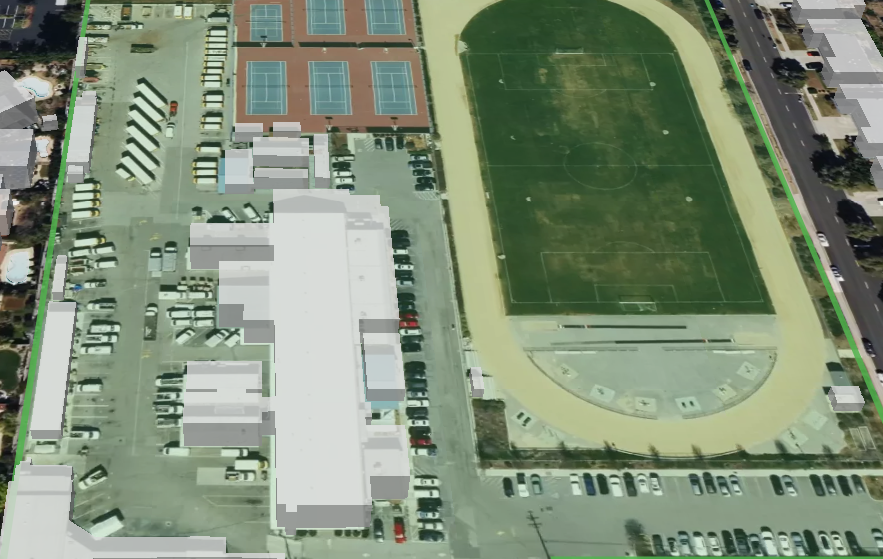
Southwest corner of Lawson Middle School could be a good alternative place. The corner is currently occupied by a lot of school buses and other district facilities. It looks like below.
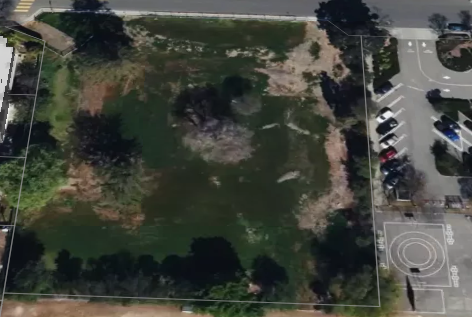
The Finch site is a 1.5 acres empty lot next to Sedgwich Elementary School. It should be a suitable alternative site if it's large enough.
CUSD Bond Measure 2024
Cupertino Union School DistrictCUSD Board discussed a potential bond measure at the 4/25/2024 Board meeting. The list of projects can be found here.
Why bonds?
As you can see in CUSD FY2023-24 Budget, CUSD budget were spent on
- Employee Salaries and Benefits (83%)
- Books and Supplies (7%)
- Services and Operating Expenditures (9%)
- Misc expenses
Only part of "Services and Operating Expenditures" can be used for facility repairs and improvements. But that's not enough. CUSD depends on bonds for facility repairs and improvements as a "tradition".
What are current bonds?
You can find all CUSD bonds on EMMA.
Residents are currently paying two CUSD bonds right now (you can check at Santa Clara County Tax Allocation).
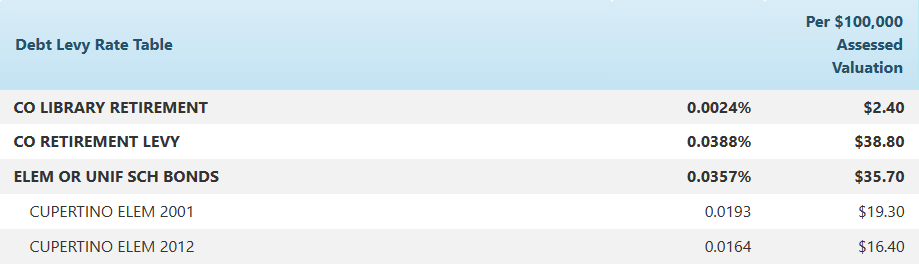
The 2001 bond should be paid off in 2027. The 2012 bond (Measure H) ran out of money in FY2022-23, but will be paid off around 2040.
What's the difference between bonds and parcel taxes?
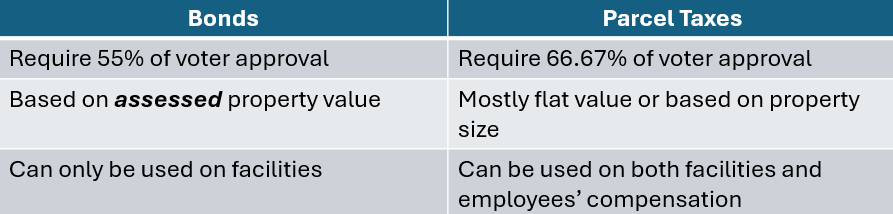
Please see this article for more information.
How bonds work?
According to Bond measure at the 4/25/2024 Board meeting,
- The district raises the money (bond) in three series
- The residents pay back the bond based on assessed property value in about 30 years (probably faster since the assessed property value should increase)
- The district uses the bond money on projects (normally last shorter than payback time, previous 2001 and 2012 bonds lasted around 10 years each)
The Official Bond Measure:
On 06/13/2024, the board voted to put modified tax rate extension on November ballot. The total bond amount is $347M. The tax rate looks like below with longer term and lower average tax rate.
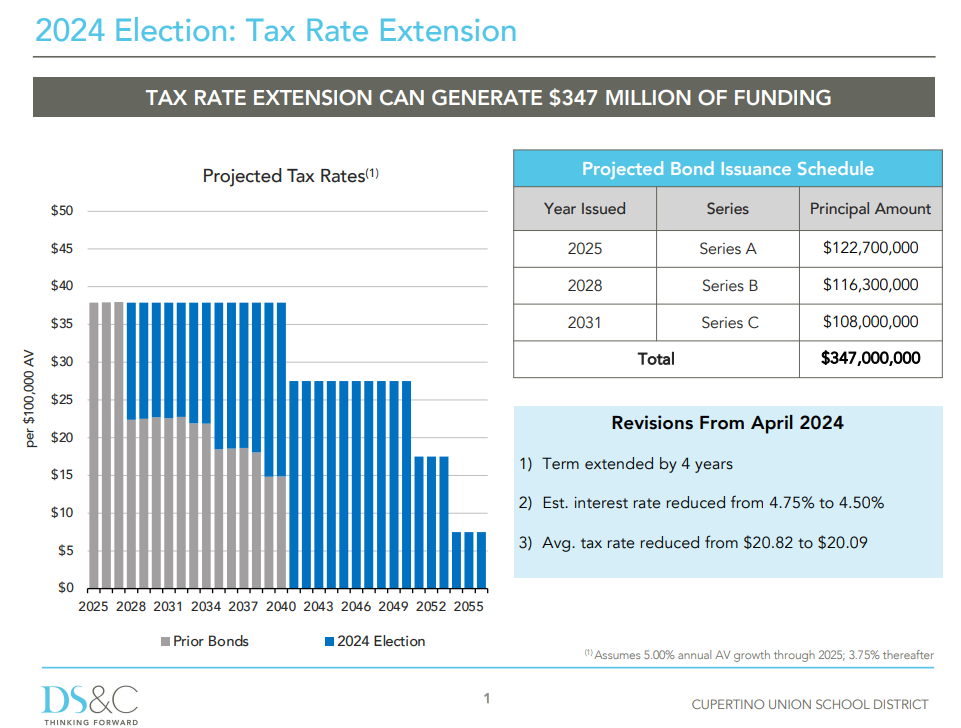
The project list for the bond is mostly generic with emphasis on new classrooms, labs for Science, Technology, Engineering, Art, and Math (STEAM). The keywords for the usage are "repair", "modernize", "renovate", "upgrade", "expand", "construct", etc. Below are the full list.
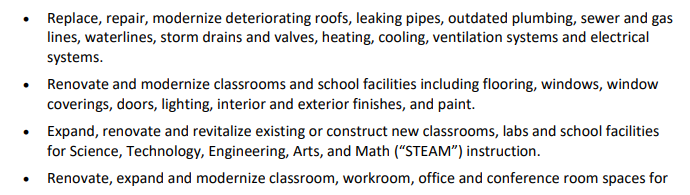
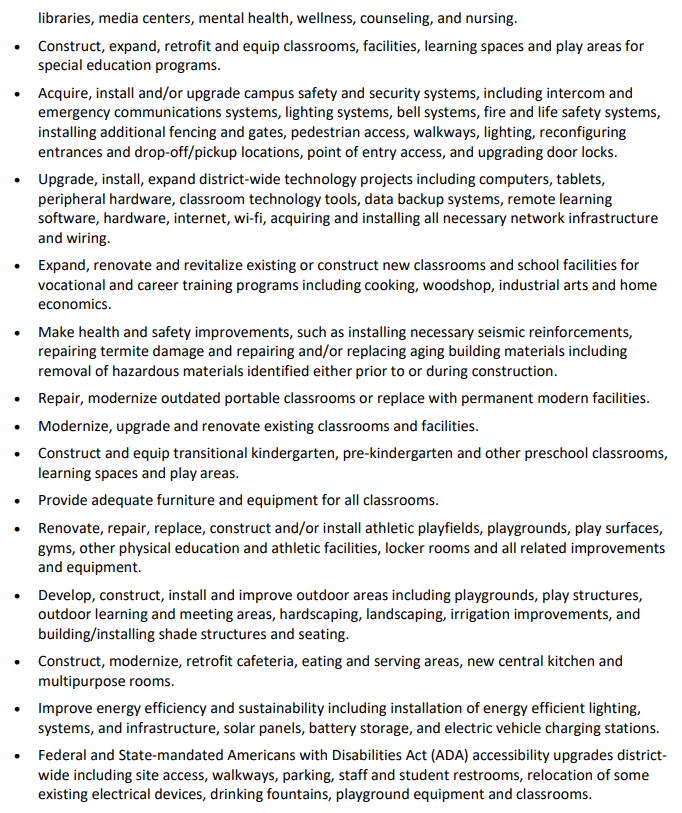
If passed, the bond will have an oversight committee and report the usage every year.
Scenarios for new bonds (obsolete)
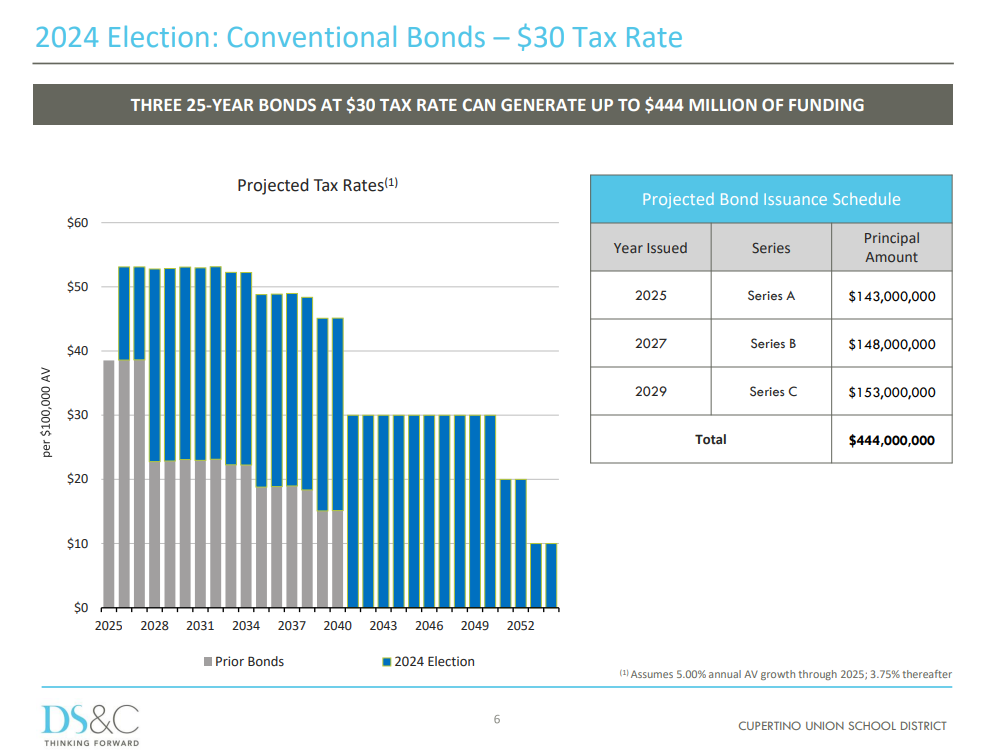
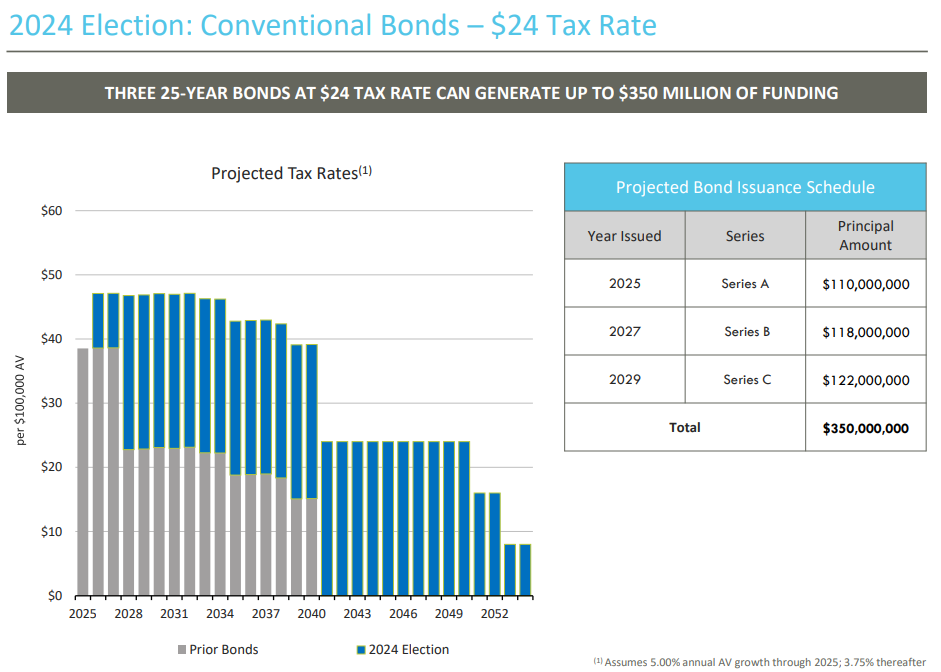
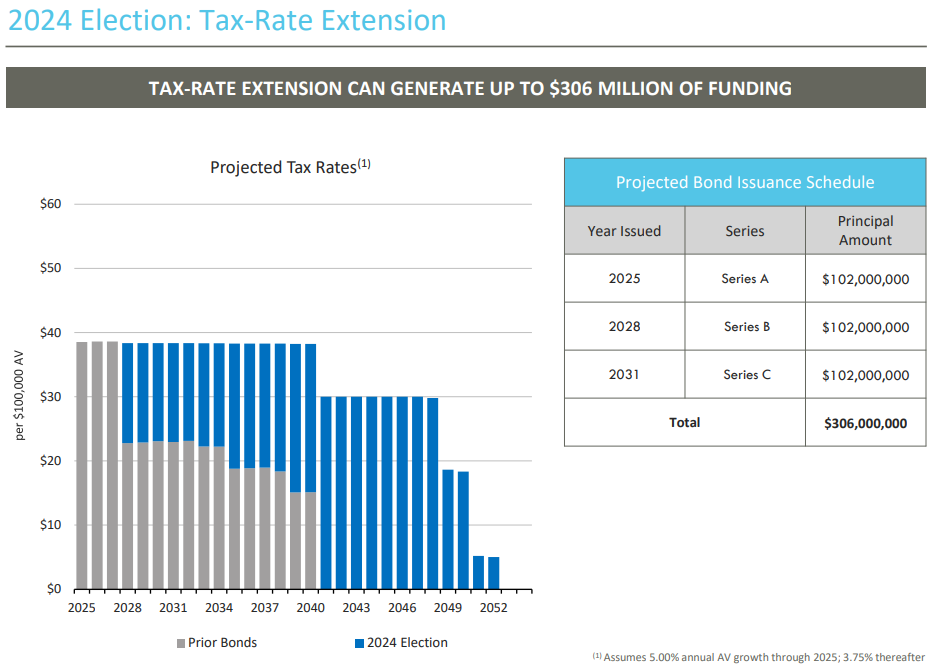
The district proposed three scenarios. Below are the screenshots where you can see residents' burden and the bond amount.
Please notice the tax rate is per $100,000 assessed value (not market value). If you property is assessed to be $2M, your burden for this bond will be 20 times the proposed tax rate per year.
Tax rate: $30 per $100,000 assessed value, total bond value: $444M.
Tax rate: $24 per $100,000 assessed value, total bond value: $350M.
Tax rate extension. Total bond value: $306M.
CUSD Financials in 2024
Cupertino Union School DistrictCUSD is about to transition from LCFF (Local Control Funding Formula) to Basic Aid in 2024-25.
California K-12 public schools have two funding models: LCFF and Basic Aid, with California setting an entitlement per ADA (Average Daily Attendance). If the school district revenue from property taxes and other sources is less than the entitlement, the district will be funded by LCFF via state funds. Otherwise, the school district will be funded by Basic Aid via property taxes.
If school district is funded by LCFF, the total revenue will be related to enrollment. The more enrollment (ADA) there is, the more revenue the district receives. If the school district is funded by Basic Aid, its total revenue will be based on the total amount of local property tax, and not related to enrollment anymore.
From Santa Clara County Tax Allocation, CUSD should receive 24.75% of the property tax (FUHSD receives 16.71% of the property tax). The total property tax rate is about 1% of accessed value.
CUSD also has two active bonds which are at 0.0357% in total. For $100K accessed value, CUSD should receive $247.50 from the 1% property tax plus $35.70 from active bonds. As a comparison, FUHSD receives $167.10 from the 1% property tax plus $44.10 from bonds.
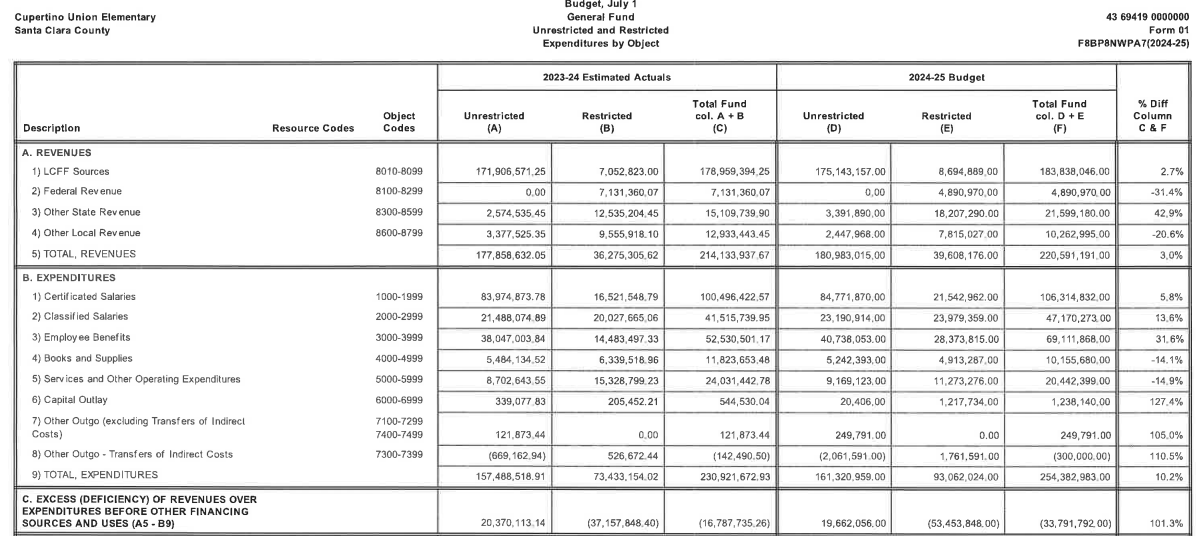
From CUSD 2023-24 budget, the revenue for CUSD is $207M in FY 2023-24, a 12% (or $28M) decrease compared to that in FY 2022-23 due to reduction in Federal, State (other than LCFF) and local revenues. But the total expenditures are $223M. So CUSD has a $16M deficit in FY 2023-24.
Within the $223M expenditures, about $185M are for employee (teachers and administration positions) salaries and benefits.
Compared to FY 2022-23, the enrollment in FY 2023-24 decreased 1.5% (from about 13,700 to about 13,500).
But the total budgeted FTE (Full Time Employee) in FY 2023-24 is 1502.540, an increase of 53.491 (3.7%) compared to FY 2022-23 (1438.174).
Budget for FY 2024-25
CUSD passed a stunning budget for FY 2024-25 with more than $33M deficit. The expense is more than 10% compared to previous year. Below is a summary of the budget.
Cupertino City Capital Improvement Programs 2024-25
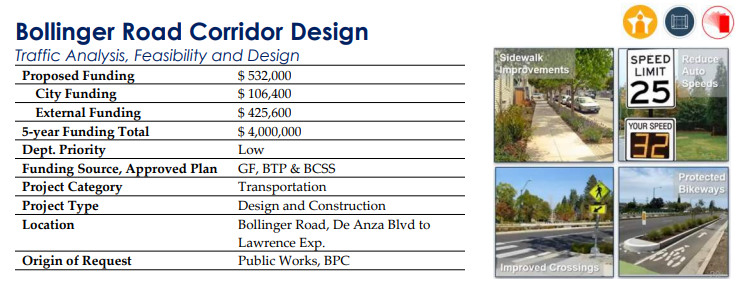
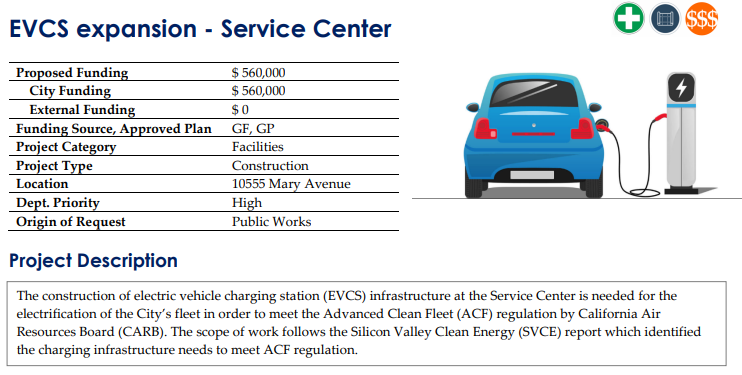
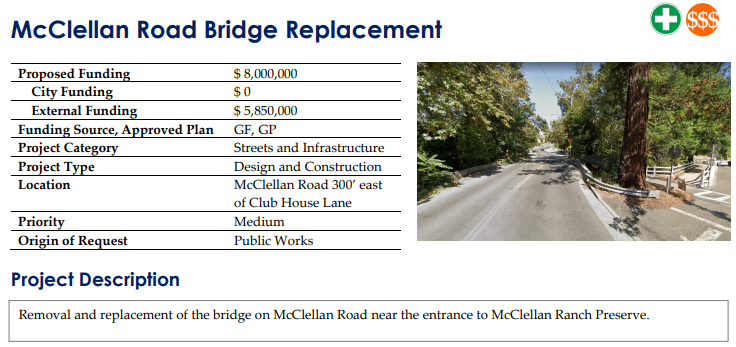
City of CupertinoCupertino City staff proposed new Capital Improvement Programs for FY 2024-25 at 3/19/2024 Council Meeting. Six (6) new projects were proposed with total cost about $19.5M.
At the same time, there are seventeen (17) existing projects with remaining funds more than $25.8M, 6 nearly completed projects, and 5 completed projects. See here for a complete list.
Because Cupertino is in a budget crisis right now, the city's capital reserve is expected to drain out in two years.
Weeks later, city staff proposed City Work Program (CWP) for FY 2024-25 at 4/3/2024 Council Meeting.
Comparing with proposed CWP staff proposed one year ago (4/4/2023), the new proposed CWP staff proposed on 4/3/2024 has a noticeable change: the new CWP didn't include any budget information. Some of the CWPs appeared in the 2023 CWP list which contains budget information. But there are some new CWPs (like "Speed Limit Lowing") totally missing budget information.
The list of new CIPs can be found here. Below are the screenshots for each of them.
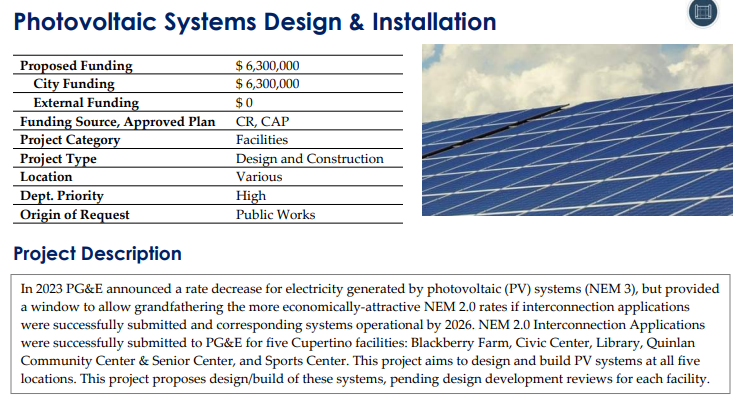
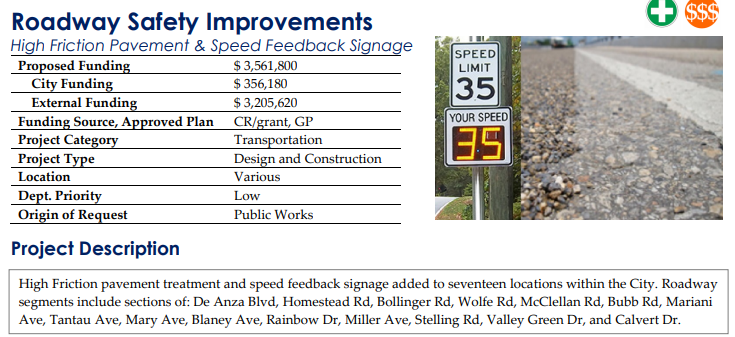
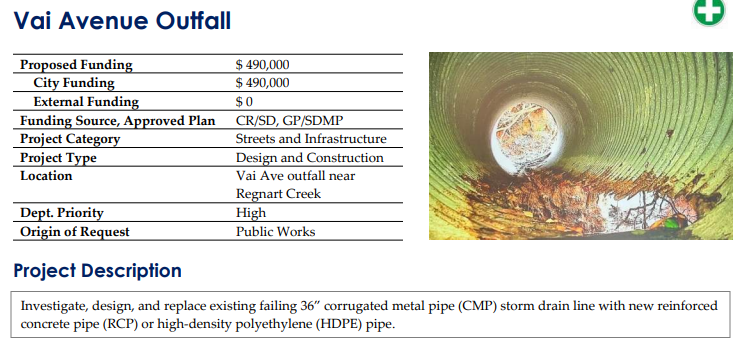
Which CIP do you support?
Bollinger Road Project
City of CupertinoBollinger Road is the boundary between Cupertino and San Jose.
In July 2021 (during Covid-19 pandemic), the City of Cupertino generated Bollinger Road Corridor Safety Study. The report provided many safety suggestions and two alternatives.
- Alternative A includes a lane reduction on Bollinger Road, from two travel lanes in each direction to one travel lane in each direction and a two-way left-turn lane.
- Alternative B maintains the existing lane configuration of two travel lanes in each direction.
You can also see related information here.
San Jose Spotlight reported on 01/22/2024 that the project is set to start this (2024) summer.
Cupertino received external funding for this project. Cupertino needs to pay 20% of the cost for design.
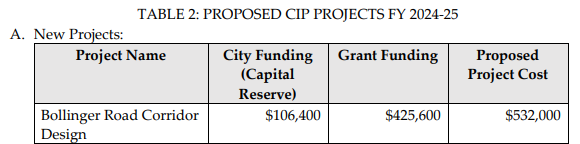
This project appeared as Low priority item on 03/19/2024 City Council study session.
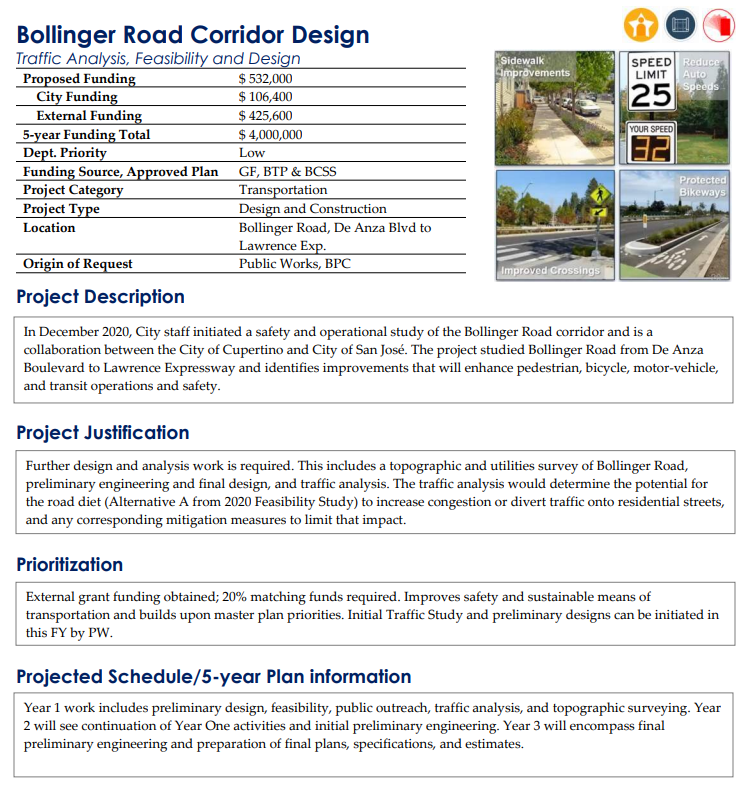
According to Bollinger Road Corridor Safety Study, the total cost for Alternative A is $11.7M, and the total cost for Alternative B is $10.5M in 2021. The project will be a five-year project. And total cost for Cupertino is estimated to be $4M.
During the public comment time, residents were split into two groups with one group supported Alternative A (lane reduction), while another group supported Alternative B (maintain lanes). Which alternative do you support?
Below are more details about Bollinger Road Corridor Safety Study.
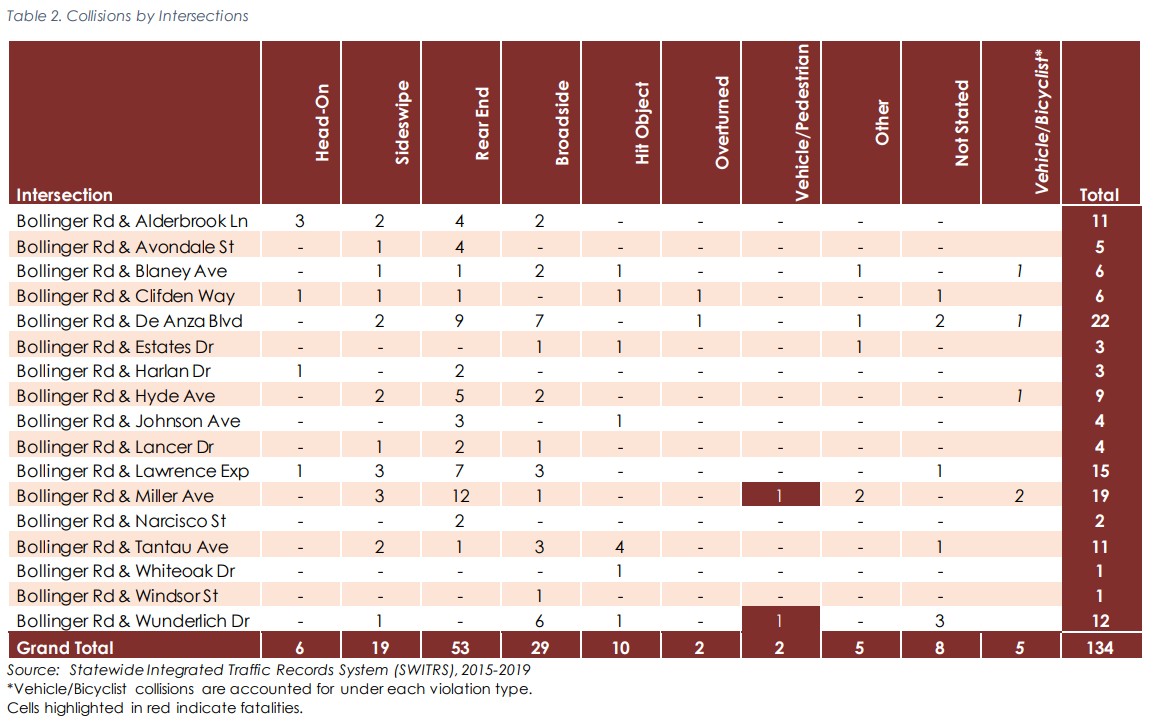
The study is a safety study with goals to "identify improvements to create a safer and more accessible corridor". According to the report, seems all the collisions happened at intersections.
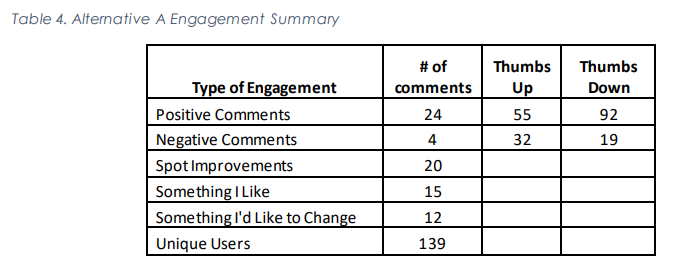
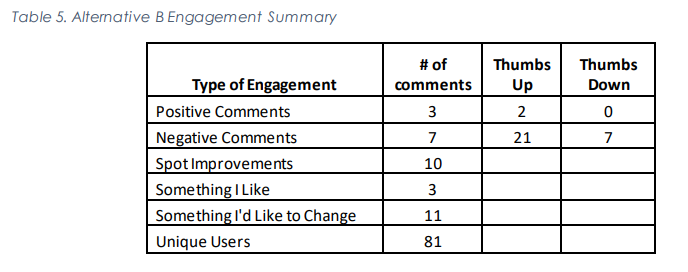
The study performed two surveys in March 2021 and May 2021, respectively. The March survey received 247 responses. While the survey in May had 139 unique users "VIEW" the maps. The report didn't mention how many responses received for the survey in May. The survey in May was about the two alternatives of reducing lanes and maintaining current lanes. Some residents reported they were aware of the survey in March, but they were not aware of the survey in May.
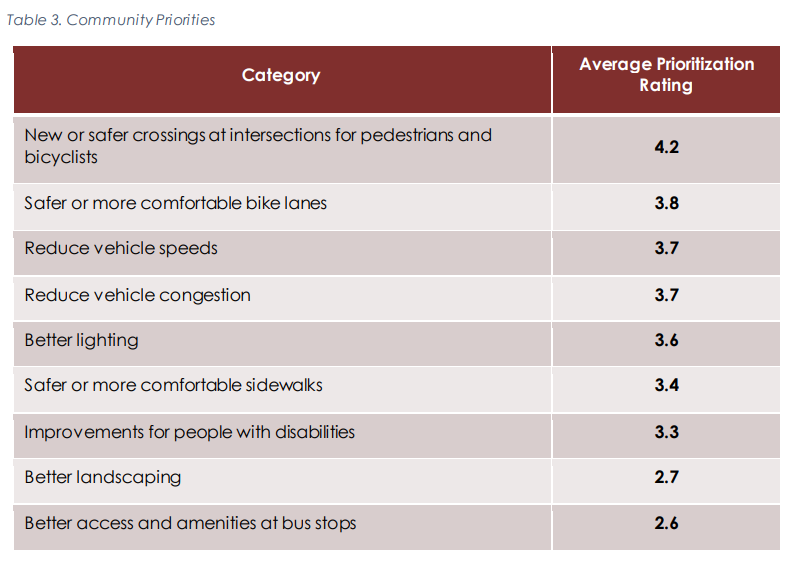
The results for the survey in March 2021 were:
The results for the survey in May 2021 were:
Cupertino Housing Element 2024
City of CupertinoCalifornia cities are expected to update their Housing Element every eight years. The Housing Element serves as the local government's blueprint for how the city will grow and develop.
The Housing Element must be approved by HCD (California Department of Housing and Community Development). HCD adopted RHNA (Regional Housing Needs Allocation) in 2021. HCD uses the RHNA methodology to specify housing allocation goals. The allocation numbers that Cupertino and other cities must now meet are generally much higher than previous cycles. An audit by the California State Auditor has outlined several weaknesses in the RHNA methodology. Here is a good article regarding the controversy regarding this issue.
California also passed many laws recently to encourage housing. Those new laws and HCD's high RHNA allocations changed cities' Housing Element dramatically. Cupertino has no exception. Cupertino's RHNA allocation is 4,588 new units from 2023 to 2031.
Cupertino has its third draft of Housing Element. To achieve the RHNA allocation, Cupertino rezoned many sites and setup many ways to increase density.
One interesting part of the Housing Element is HE-1.3.6 (page H-17 of the Housing Element third draft). The first bullet says "Allowing corner lots in R1 zoning districts to develop as multi-family rental housing using R3 zoning regulations to encourage missing-middle developments." R1 means single family house. R2 means duplex. R3 is not triplex, but multi-family housing. All apartments in Cupertino so far are R3. This means all the corner lots can become apartments without additional parking requirements.
The second bullet says "Allowing lots zoned for single-family residential uses that abut (either shares a property line or is directly across the street from) property that fronts an arterial or major collector, and is zoned and used for commercial or mixed-use development, to develop with rental multi-family housing using R3 zoning regulations to encourage missing middle housing. "
This means properties located behind or around a shopping center can become apartments. Probably many people live there didn't realize they are impacted.
Arterials:
- Homestead Rd
- Stevens Creek Blvd
- De Anza Blvd
- Wolfe Rd
Major collectors:
- N. Tantau
- Miller Ave
- N. Stelling
- Bubb Rd
- N. Foothill Expressway
Below is an incomplete list of impacted streets:
- Near Homestead ** Shady Oak Ln ** Firethorn Dr
- Near Stevens Creek Blvd ** Norwich Ave - all of east side ** Amherst Dr-east end ** Denison Ave-south end ** Wheaton Dr-all of south side ** Stern Ave-north end ** Bret Ave-north end ** Judy Ave-north end ** S Tantau Ave-north end ** E. Estates Dr-north end ** Richwood Dr-north end ** Bixby Dr-all of north side ** Brenda Ct-north and east end ** Mello Place-north end ** Deeprose Pl-north end (possibly) ** Randy Lane-south end close to Stevens Creek Blvd ** Miner Place-north end, south end ** Partlett Place-north end, south end and by Donut Wheel ** Scofield Dr – all of it ** Alves Dr-between Sachi Way and Stelling ** Peninsula Ave-south end ** Santa Clara Ave-south end ** Adrian Ave-south end ** Eaton Place-east end ** Ramona Ct-north end ** Northeast side of Stevens Creek Blvd near N. Foothill Expressway ** Cupertino Rd-west end
- De Anza Blvd ** Sunrise Dr-east end (possibly) ** Rodrigues Ave-behind XLB Kitchen shopping center ** Terry Way-east side ** Paradise Dr-east side ** McClellan Rd-northeast and southeast end ** Felton Way-east side ** Blossom Ln-east end ** Kirwin Ln-east end ** Westlynn Way- east side (possibly) ** Jamestown Dr-east side ** Clifden Way – west end ** Clay St – west end ** Silverado Ave – west end
- Bollinger ** Clifden Way-west side ** La Roda Dr-south end ** S Blaney Ave-southwest end
Cupertino Budget Deficit and Measures to Balance It
City of CupertinoDue to a state audit, Cupertino will lose $30M online sales tax per year.
For FY 2023-24, Cupertino reduced the budget to $110M (the budget was $130M for FY 2022-23), a $20M reduction compared to previous fiscal year. The $20M reduction was mainly Service-Level Reductions.
But there are still more than $10M deficit. The city expects the deficit to increase to $15M in next ten years.
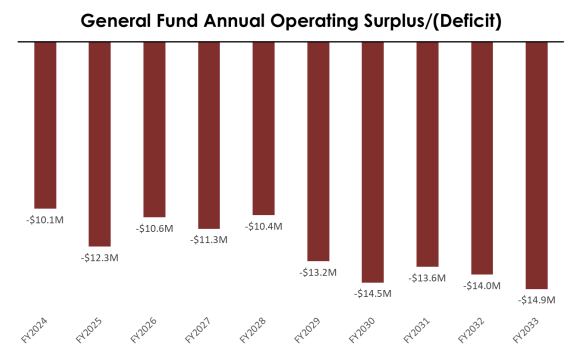
In 2024, the city is seeking more measures to close the $10M deficit. The efforts include:
At the same time, Cupertino Voice performed some budget related surveys. One promising measure with voter approval is to “Scaling back the Staff Per 1,000 Residents to FY 2014-15 level". This measure alone could save the city about $9M per year. But the City Council haven't considered this measure.
Cupertino's Potential Service-Level Reductions for FY 2024-25
City of CupertinoDue to a state audit, Cupertino lost about $30M online sales tax per year.
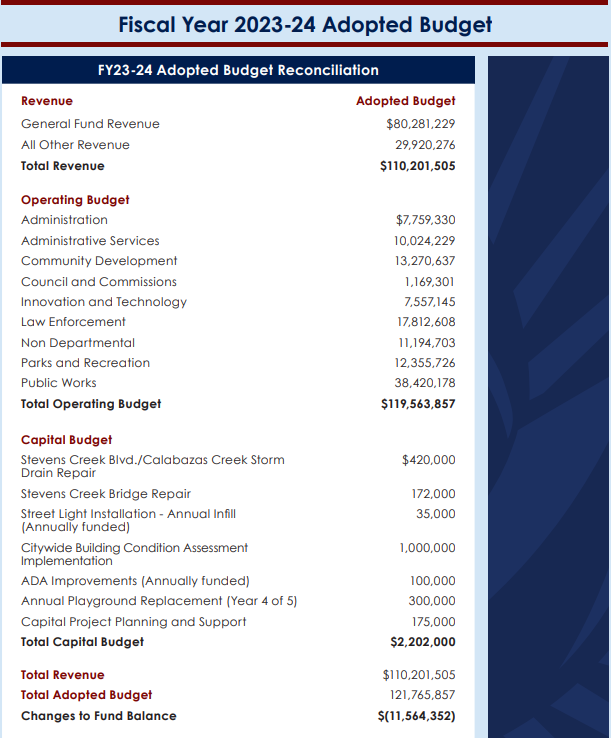
For FY 2023-24, Cupertino reduced the spending to $120M (the spending was $130M for FY 2022-23), a $10M reduction compared to previous fiscal year. The $10M reduction was mainly Service-Level Reductions.
Below is a screenshot for FY 2023-24 budget.
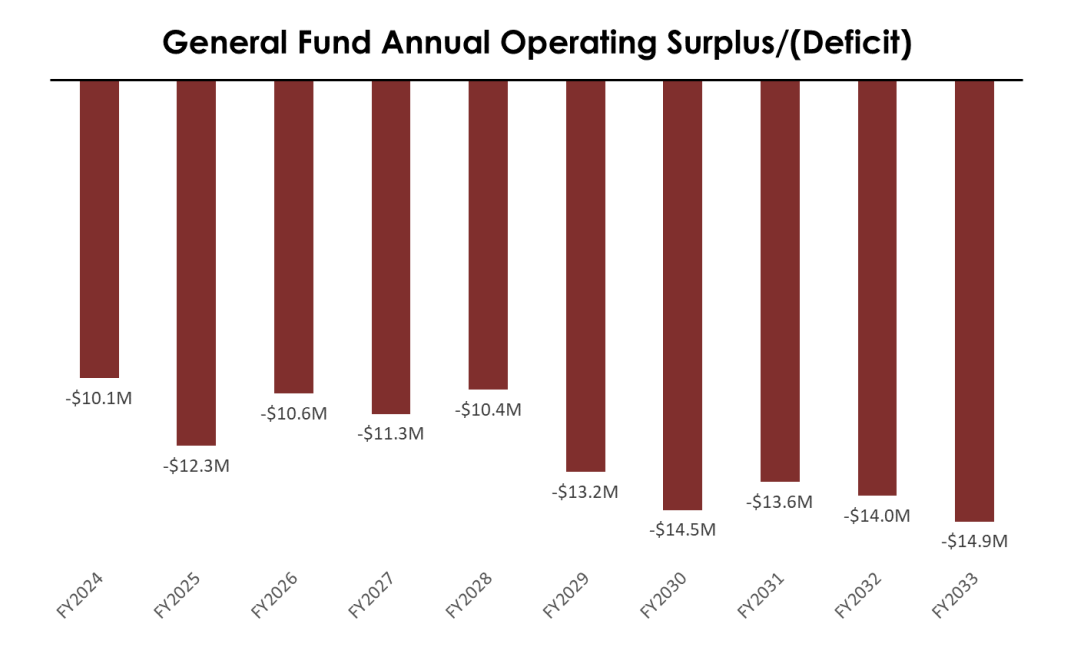
According to staff report on 01/17/2024 (snapshot on 1/23/2024, the original link is here which will download a file to your computer), even with budget cutting made in FY 2023-24, Cupertino is still facing $10M budget deficit. And the gap will grow up to $15M in ten years.
To reduce the budget deficit, the City Council is seeking to
- Increase revenue with new taxes and increasing fees for city services
- Reduce spending with potential service-level reductions (snapshot on 1/21/2024. The original link is here which will download a file to your computer).
At the same time, Cupertino Voice performed some budget related surveys. One promising suggestion for reducing the budget, endorsed by a majority of respondents to Survey #2, was to “Scaling back the Staff Per 1,000 Residents to FY 2014-15 level". This measure alone could save the city about $9M per year. The results of Survey #2 were shared with the City Council with both oral and written communications.
City staff proposed a list of 32 potential service-level reductions (SLR). Most of them will affect residents everyday life.
Cupertino Facts also had a nice article covers this topic.
Below are sceenshots for those SLRs
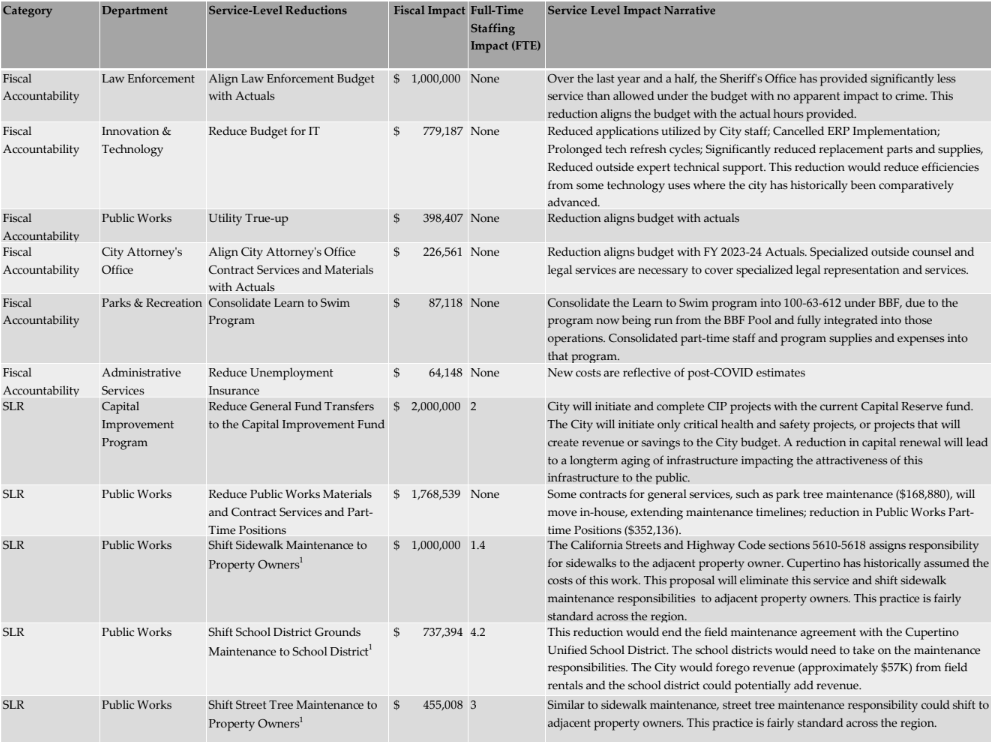
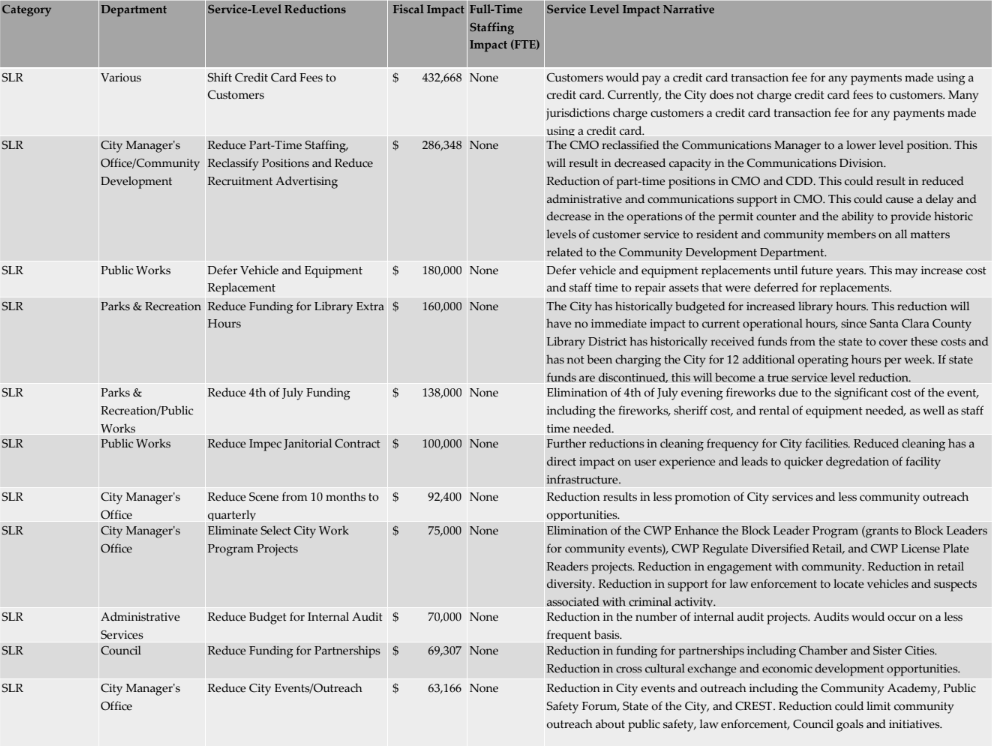
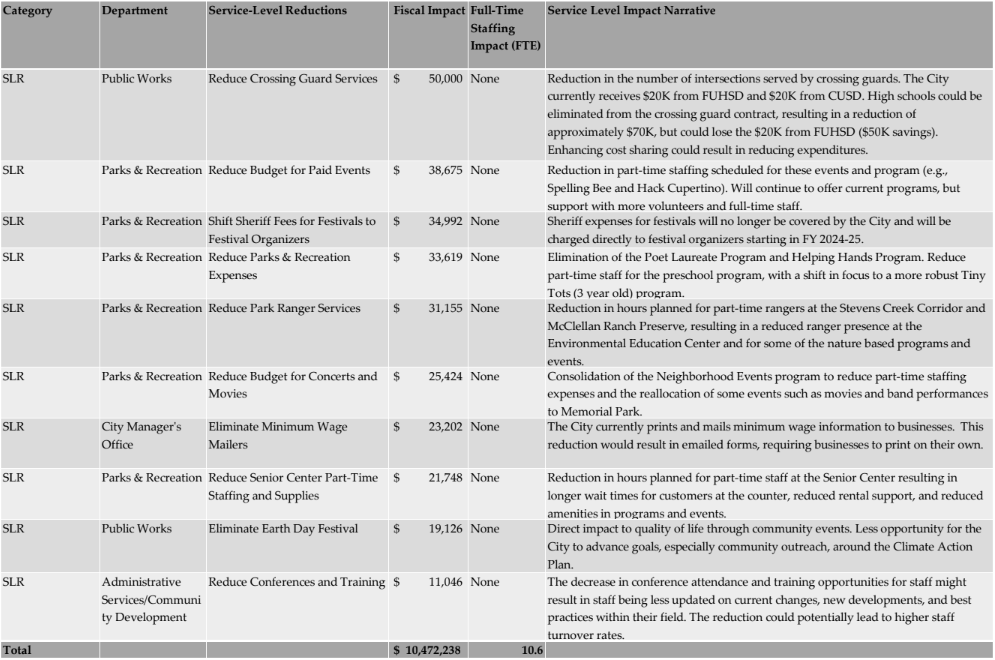
Cupertino New ADU Policies
City of CupertinoOn 11/14/2023, the Planning Commission of Cupertino made significant changes about Accessory Dwelling Unit (ADU) policies. The changes include:
- Allow up to three ADUs on a single family lot (page 19 of the redline) ** Old rule: only one ADU in general, two ADUs with conditions
- Increase the height limitation of ADUs (page 20 of the redline) ** Detached, new rule: 18 feet, old rule: 16 feet ** Attached, new rule: 25 feet, old rule: N/A
- Two-story ADU allowed (page 20 of the redline) ** Old rule: Only conversion of existing two story part of primary dwelling unit allowed
- Two-story permit is eliminated for primary dwelling unit (page 13 of the redline)
No new parking requirement was added for ADUs.
The maximum three ADUs per lot could be in any combination of the following, taking into consideration other existing zoning standards:
- One attached ADU
- One conversion of existing space ADU (whether in principal dwelling unit or existing accessory structure)
- One detached ADU, or
- One Junior ADU
The redline of the changes can be found here. Note: the document was downloaded from City Council item on 12/06/2023. It was uploaded to Google Drive so you don't have to download a pdf file for every click.
The minutes of the meeting can be found here.
Cupertino's Possible New Taxes on 2024
City of CupertinoAccording to Bloomberg Tax, Cupertino City Council weighs four tax options to fill in Apple revenue loss. The council must decide by June to make the options appear on the November 2024 ballot.
City of Cupertino published a survey for business community at here.
The four tax options are:
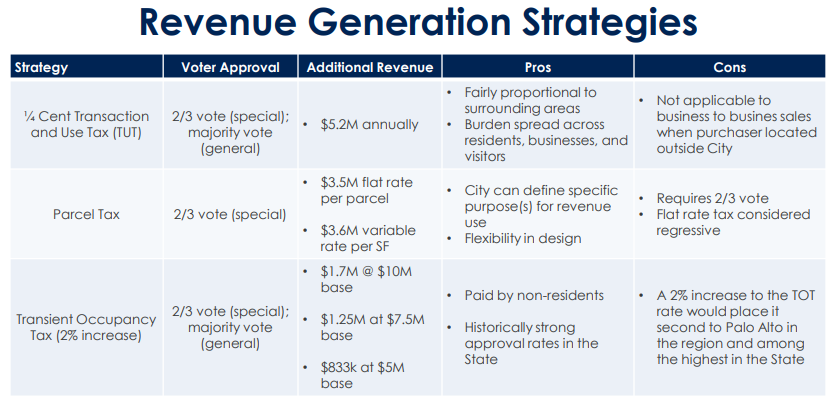
- A 0.25% local transaction and use tax, which would be added to the 9.125% sales tax. It would be levied on purchases made in Cupertino and allocated to the city. The city expects this tax would raise $5.4 million annually.
- An increase from 12% to 15% in the city's transient occupancy tax on lodging, which would raise $1.9 million per year.
- A parcel tax levied at a flat rate or several progressive rates on homes and businesses, which would raise $3.7 million per year.
- A business operations tax levied at progressive rates based on some measurable aspect of the business operations, such as: gross receipts/payroll, number of employees, square footage of business, etc. BOT would raise $4.1 million per year.
Transaction and Use Tax is different from sales tax. Sales tax is based on Point of Sale, while TUT is based on Point of Delivery. Cupertino residents should pay TUT when they shop online since TUT applies to delivery address. Anyone shopping in Cupertino businesses also should pay the increased TUT.
Cupertino's current sales tax is 9.125%. With 0.25% hike, the new tax rate will be 9.375%. As comparison, Sunnyvale, Santa Clara, Saratoga, and Los Altos have sales tax rate at 9.125%. While sales tax in San Jose is 9.375%.
The city's survey suggested the Business Operation Tax being considered is employee head tax. Many businesses, including Apple, expressed they oppose such tax before. But that happened before Apple sales tax loss. Apple mentioned they would stop any future growth in Cupertino if employee head tax is levied.
The parcel tax applies to each home and business. It can be either flat rate or per square foot. Flat rate has more impact for individual home owners than large landlords since they would pay the same amount regardless the size of the property. The city's survey suggested flat rate Parcel Tax is being considered. Bloomberg has an article A Progressive Parcel Tax Could Solve Cupertino’s Budget Woes.
Transient Occupancy Tax applies to lodgers in Cupertino hotels. It doesn't affect residents directly, but may affect hotel business.
Below is a copy of this article on Bloomberg Tax by Laura Mahoney
Cupertino Weighs Four Tax Options to Fill in Apple Revenue Loss December 5, 2023, 7:47 PM PST
o City council faces June deadline to decide o Revenue loss tied to state’s review of Apple sales tax agreement By Laura Mahoney / December 5, 2023 10:47PM ET / Bloomberg Law Leaders in Apple Inc.'s hometown of Cupertino are considering a menu of four tax increases to make up for the loss of revenue from the company’s online sales. The Cupertino City Council voted 4-1 on Tuesday to direct its staff to ask businesses in the city for their input on the tax ideas and report back in January, when the council will also be considering budget cuts to help close a $15 million deficit due to the state’s actions. Next, the council could consider narrowing the options for possible placement on the November 2024 ballot after polling residents to gauge support. The council must decide by June. The four tax options are: • A 0.25% local transaction and use tax, which would be added to the 9.125% currently levied in Cupertino that includes statewide sales tax and six different county or regional special taxes. It would be levied on purchases made in Cupertino and allocated to the city, and would raise $5.4 million annually. • An increase from 12% to 15% in the city’s transient occupancy tax on lodging, which would raise $1.9 million per year. • A parcel tax levied either at a flat rate or several progressive rates on homes and businesses, which would raise $3.7 million per year. • A business operations tax, or employee tax, levied at progressive rates based on the number of employees, which would raise $4.1 million per year. Cupertino is facing the choices because the California Department of Tax and Fee Administration is scrutinizing whether Apple improperly designated the city as the location of online transactions for iPhones, MacBooks, Airpods, and other products sold in California. The city has an agreement with Apple to give 35 cents of every dollar to the company, and has paid Apple $107.7 million since 1998. The council has already set aside $56.5 million to repay the department for sales tax it has received since April 2021 and expects future sales tax revenue could drop by 73%. The city is appealing the department’s determination, but that process is expected to take months or years and could end up in state court. Council members, who did not name Apple during the hearing, opted to ask the business community for input first instead of taking recommendations from its staff and a consulting firm that analyzed options to begin polling residents on their support for the transaction and use tax. That option, which would require a majority of voters’ approval, would keep the city’s tax rate competitive with its neighbors’ and be spread across residents, businesses, and visitors. Even if the city enacts a tax increase, it will still face an annual budget shortfall of at least $10 million, said Kristina Alfaro, director of administrative services. To contact the reporter on this story: Laura Mahoney in Sacramento, Calif. at lmahoney@bloombergindustry.com Link to story: https://news.bloombergtax.com/daily-tax-report-state/cupertino-weighs-four-tax-options-to-fill-in-apple-revenue-loss
Don’t make me wrong. I like the idea of Democracy. But I don’t like our current practices of Democracy.
Our current practice is the Trustee Model of Representation. Voters vote for a candidate based on the belief that the candidate will represent them properly. Once elected, the representative works on their own for two, four or six years based on the length of the term. But voters basically lose control of their representative.
This model fails in both theory and reality.
There are only four ways of spending money.
- You spend your own money on yourself. Our everyday life works on this model. Fortunately it is also the most efficient way of spending money — you always try to spend your own money in a way that serves you the best.
- You spend your own money on someone else. Thinking of giving gifts for a coworker’s baby shower. You tend to not care about the gift, with staying under the budget being your main concern.
- You spend someone else’s money on yourself. One legal case is that if you are on a business trip your company can compensate for meals. You tend to spend as close to the limit as possible.
- You spend someone else’s money on someone else. You tend to not care about how much you spend and how the money is spent. Unfortunately, our Government falls in this model.
The case is not only limited to money, but to everything, like natural resources and even the safety of the society. Even worse, most representatives are trying to convert some resources from Model 4 to Model 3, which is they can benefit from the resources they control for all the people. That’s why most people think their representatives are out of touch and even corrupted. Representatives who wholeheartedly work for the people are rare. You should cherish them if you are lucky enough to have some.
Is there any solution? Fortunately, the answer is yes. With the help of modern technology, we can convert representatives to the Delegate Model of Representation. In this way, people as a whole controls how to spend their own money on themselves. Suddenly we return to the model 1 of spending, which is also the most efficient way.
It will also be the first time to fulfill an American dream: the Government should be of the people, for the people and by the people.
Fighting Crimes
City of CupertinoA House Divided
City of CupertinoThe Civil Grand Jury of Santa Clara County published a report A House Divided: Cupertino City Council and City Staff.
The report shows there is a tension between the City Councilmembers and the city staff.
City of Cupertino hired Linda Daube to investigate issues raised in the report. Linda returned to the Council with her Fact Finding Report.
In the City Council Meeting of 5/9/2023, the council majority (Mayor Hung Wei, Vice Mayor Sheila Mohan, and Councilmember J.R. Fruen) made some unpreceded decisions, including
- Remove all committee assignments from Councilmember Chao and Councilmember Moore.
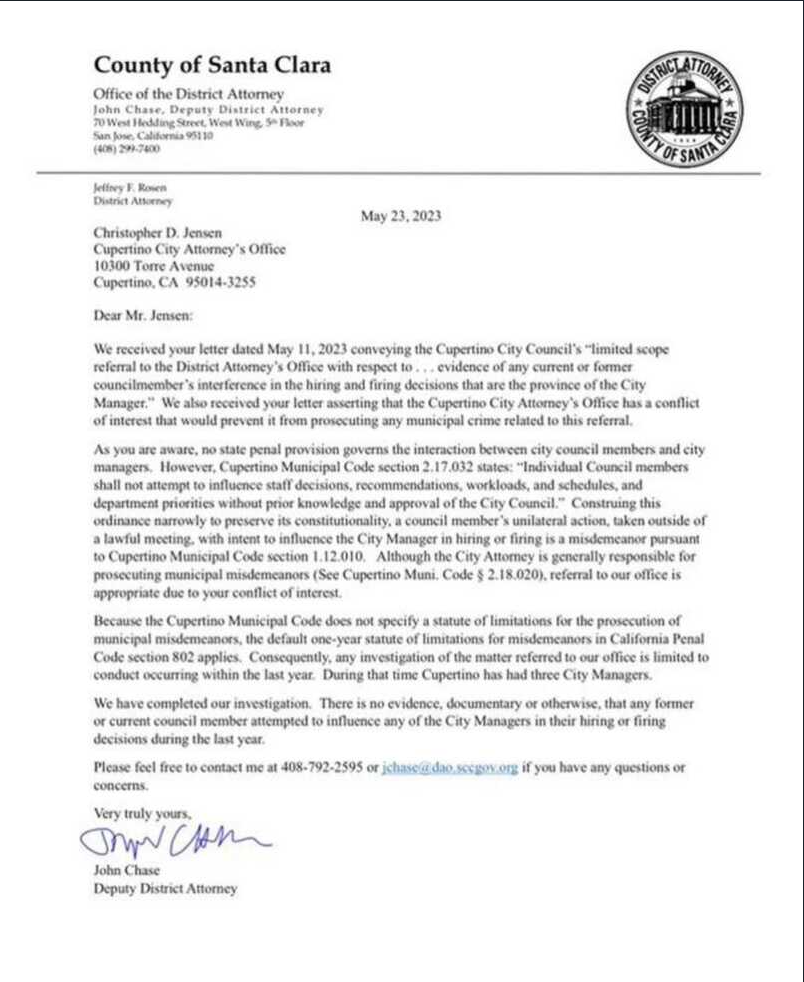
- Referred Santa Clara County District Attorney to investigate current and former councilmember (including former Mayor Paul) to see if they had unduly influenced the City Manager or City Staff in hiring or firing decisions.
- Went ease for City Staff and didn't ask for any improvement in response to the Civil Grand Jury report.
The interesting thins is the Deputy District Attorney responded to the referral in a short 9 business days and claiming "There is no evidence ... that any former or current council member attempted to influence any of the City Managers in their hiring or firing decisions".
San Jose Spotlight covered the story.
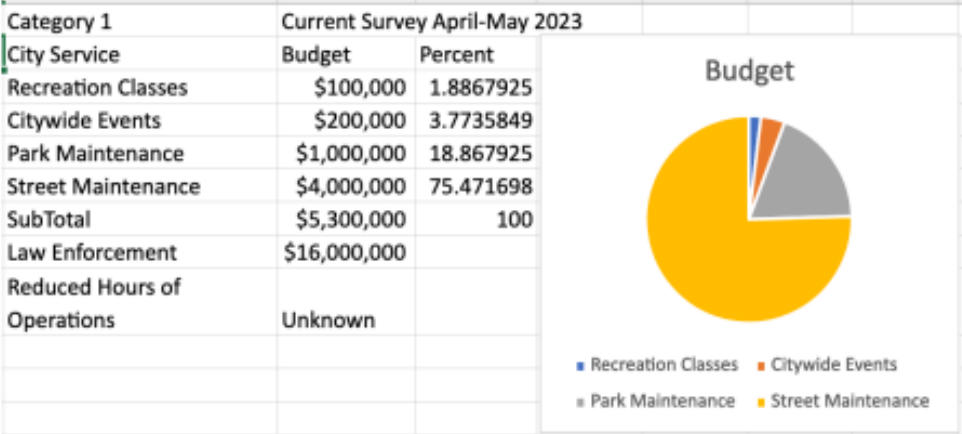
Cupertino City 2023 Community Budget Survey
City of CupertinoCupertino City published a Community Budget Survey to get community input for the budget crisis.
But the survey only covered a small portion of total budget.
Cupertino City Hall
City of CupertinoCupertino City Hall was designed and built in 1965. The size is about 24,140 square-foot (indicated here). It doesn't meet the current building standards. Please see here for more information. We need to do something to make it meet current standards.
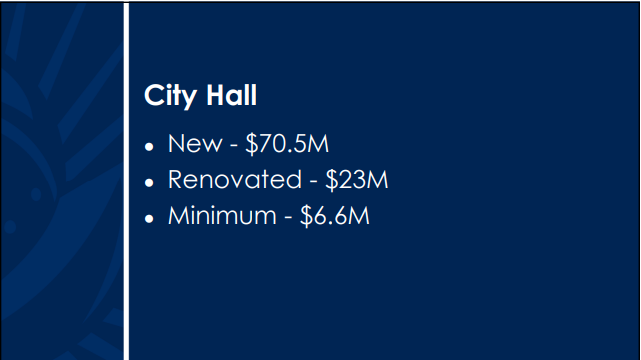
There are three options according to a 04/30/2019 report:
- Building new City Hall - $70.5M
- Renovated - $23M
- Minimum - $6.6M
Neighboring city Sunnyvale just built a new 120,000 square-foot City Hall. And the first phase cost was about $315M (see here). So the per square-foot cost is about $2625.
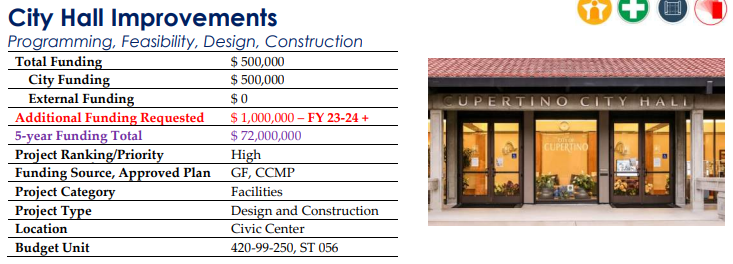
On 11/15/2022, Cupertino City Council directed the staff to include the City Hall Renovation with $27.5M to next FY budget (see here).
On 02/11/2023, the new City Council preferred a new 80,000 square-foot City Hall. If we take the Sunnyvale new City Hall's per square-foot cost number, the cost would be $210M, which is much more than proposed $70.5M.
New City Hall was included in the FY 2023-24 five year plan for CIP.
Given Cupertino is in a budget crisis, which option for the City Hall do you think Cupertino should take?
City Hall appeared on the agenda of 10/17/2023 as item 7: "Direct staff to pursue conceptual development of a mixed used Public Private Partnership for City Hall and the Sports Center properties".
Cupertino Budget Crisis
City of CupertinoAbout 40% of the City of Cupertino's revenue comes from sales taxes. But with a state audit, the sales tax revenue is estimated to drop 73% this year, from $42.1 million to $11.4 million, a $30.7 million change. The City of Cupertino's budget will change from surplus to deficit. See staff report for details.
Below is a screen shot of the staff report.
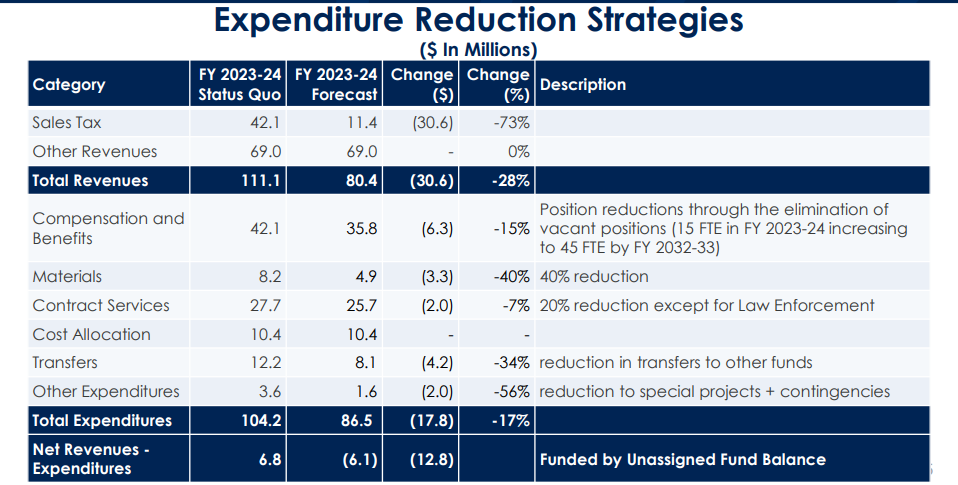
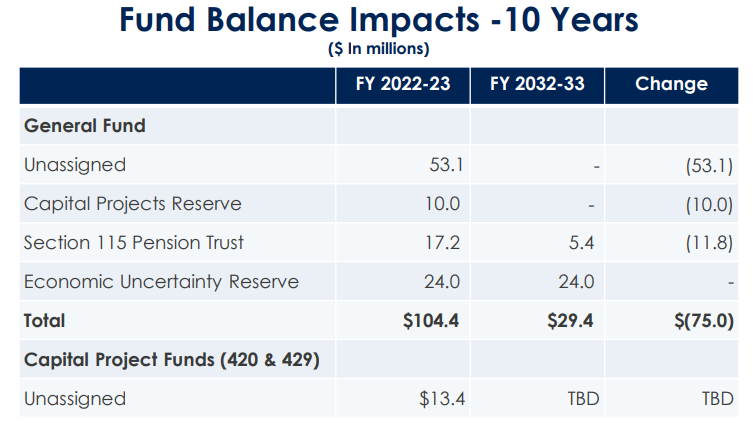
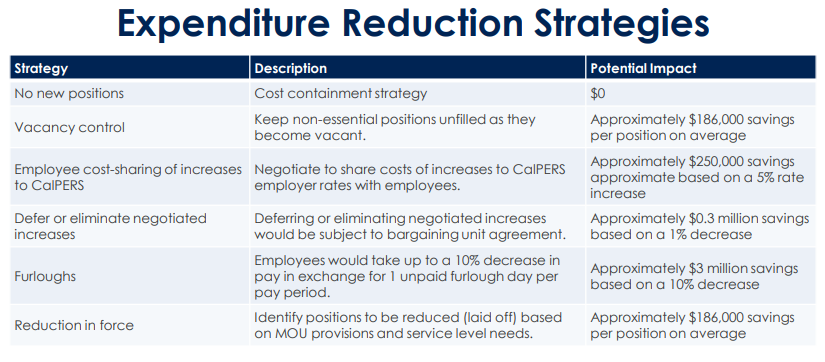
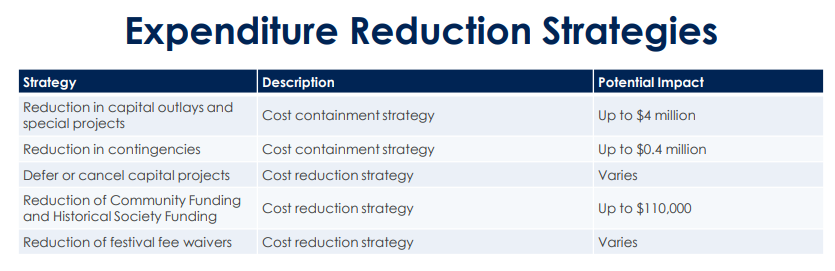
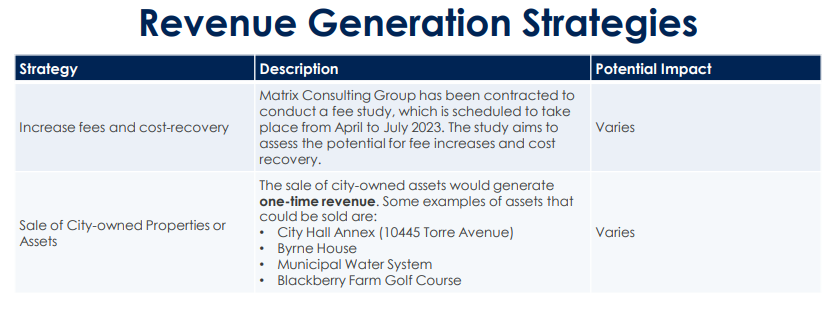
The city offered three strategies: reduce fund, cut expenditure and increase revenue.
Below is a screen shot of fund reduction.
Below are screen shots of expenditure reductions.
Below are screen shots of increasing revenue.
The City of Cupertino is conducting a survey. How should Cupertino balance its budget?
Below are some ideas not offered in the city survey above.
- A hiring freeze while the budget is in deficit. The Staff per 1000 residents ratio is at all time high (3.40). How about scale it back to FY 14-15 level (2.62)?
Given the population is 60,869 in FY2023-24, we can save 47 to 52 positions. Each position costs about $186,000 per year (See Expenditure Reduction Strategies above). The saving is about $8,742,000 to $9,672,000 per year.
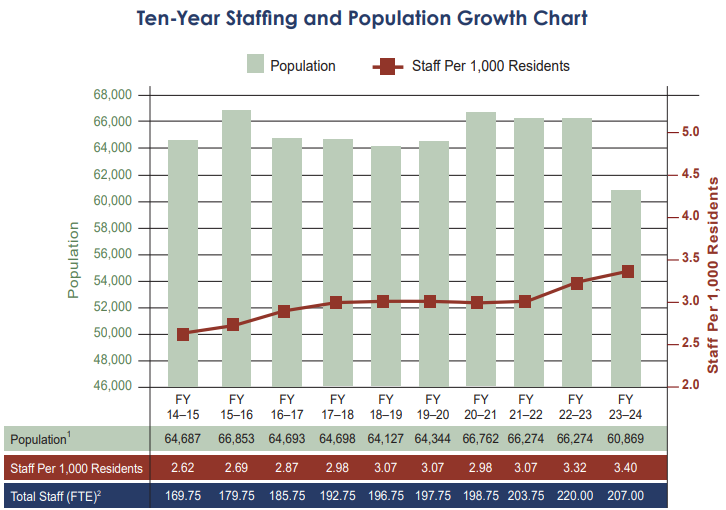
Note: Cupertino Budget At A Glance for FY23-24 shows 207 total staff for FY23-24, while page 42 of Cupertino Adopted Budget for FY23-24 shows 212 total staff. The Budget At A Glance shows 10% population reduction for FY23-24. I don't know whether this is accurate. So used previous year's population number for calculation.
- Freeze city staff salaries and benefit unless the budget is balanced or has a surplus. This will encourage city staff to pursue a balanced budget as well.
- Cupertino pays Santa Clara County Sheriff each year for law enforcement services. But cities like Sunnyvale (larger than Cupertino) and Campbell (smaller than Cupertino) have their own police department. Should Cupertino study the strategy to have its own police department?
Cupertino Reserving $56.5 Million to Repay Tax from Apple Sales
The related survey can be found here.
There are two representation modes: trustee model of representation and delegate model of representation.
Almost all the current representatives are in the trustee model of representation. People are familiar with this model since the beginning of Democracy. But people chose this model not because it is good, but because they had to use this model due to technical limitations.
Representatives need to make laws and policies. They need to 1. communicate to each other efficiently, 2. vote quickly. In the old days, people have to stay in the same room to achieve both. Democracy system had to use representatives and representatives had to run on trustee model of representation due to the technical limitations.
But with today's technology, people can communicate and vote online which can overcome the two requirements easily. Current law still requires representatives. But representatives can run on delegate model of representation, so the constituents make the decision directly.