Threads
Official ballot title: Prohibits Citizens From Voting Unless They Present Government-Issued Identification. Initiative Constitutional Amendment. (November 3, 2026 statewide ballot) — commonly called the voter ID measure.
A neutral summary to help you decide, drawn from the nonpartisan Legislative Analyst's Office (LAO), the measure's official text (CA Attorney General), and campaign/finance data compiled by Ballotpedia. Always treat the state Voter Information Guide as authoritative. Links at the bottom.
What it does
Proposition 39 changes how voters prove their identity, and adds citizenship-verification and audit requirements:
In-person voting: requires voters to present government-issued ID.
Vote-by-mail: requires voters to select a government-issued ID during registration and write the last four digits of that ID number on the ballot envelope; officials verify it matches.
Free voter ID card: the state must provide a voter identification card at no cost to anyone who requests one.
Citizenship verification: requires elections officials to make "best efforts," using government data, to verify that registered voters are U.S. citizens, and to report each year the share of each county's rolls that have been citizenship-verified.
Audits: the State Auditor must review state/county compliance in every odd-numbered year.
Implementation: the Legislature must pass additional laws to fill in details the measure leaves open (e.g., which IDs qualify, what counts as "best efforts").
What your vote means (LAO wording)
YES: voters would be required to present additional identification to vote.
NO: a voter's identity would continue to be established as it is today (e.g., signature for in-person voters).
Fiscal impact (per the LAO)
Increased state and local costs of tens of millions to low hundreds of millions of dollars per year to implement the new requirements — less than one-quarter of 1% of the state budget.
Costs depend on future design/implementation decisions; any savings likely would not exceed the costs.
Background
U.S. citizenship is already required to vote in state and federal elections (and almost all local ones), and lying about citizenship to register is already a crime. Today, in-person voters typically identify themselves by signing the roster; most Californians vote by mail (about 13 of ~16 million in November 2024). Prop 39 would add ID/verification steps on top of the current system.
A closer read of the actual text
(Our own read of the measure's 2-page text — including what it leaves out. Each point states what the text says; a Reading: note marks where we're interpreting it.)
It's a constitutional amendment — it adds Article II, § 3.1 to the state Constitution. Reading: that entrenches it — the Legislature can't repeal or soften it; only another statewide vote (or a court) can change it.
The text does not say which IDs qualify. It defines "government-issued identification" circularly — "documentation that allows conclusive verification of the voter's identity" — and leaves the actual list to the Legislature. So whether a driver's license, passport, or the new free state voter-ID card counts is undefined in the measure itself.
Self-executing, yet needs implementing laws — and lets citizens sue to force it. The text says it's "self-executing," but also directs the Legislature to "promptly enact" implementing laws and gives citizens the right to "seek judicial review and remedy" of compliance. Reading: if a reluctant (currently Democratic) Legislature stalls, the private right of action plus the State Auditor's odd-year audits are the levers to compel it — so litigation is likely baked in.
Ballots aren't counted until identity is verified — and officials must also confirm the person cast only one ballot. For mail ballots, the last four digits must match the ID the voter designated at registration.
The biggest thing the text leaves out: a cure process. It says nothing about what happens if a mail voter's digits are missing/mismatched, or an in-person voter has no ID — whether there's a provisional-ballot cure window. Reading: the entire "election integrity vs. disenfranchisement" debate turns on that undefined detail, which the Legislature or courts would have to fill in.
"Best efforts" citizenship verification — officials must use "best efforts" with government data and report the verified percentage yearly; "best efforts" is not defined.
Severability clause — if a court strikes part, the rest stands. Notable, since the title is already being litigated.
Named proponents: the measure was submitted by Assemblymember Carl DeMaio and Senator Tony Strickland (with Californians for Voter ID) — useful context on who's behind it.
Who supports it
Committee: Yes on 39 / Californians for Voter ID, which reported about $17.2 million raised.
Top funders: Richard Uihlein ($4.0M), Steve Bray ($3.5M), Ken Calvert for Congress ($300K) — i.e., largely a few large national donors.
What supporters say: it adds a layer of election security, helps prevent fraud, and keeps noncitizens from voting.
Who opposes it
Committees: No on Prop 39 – Californians for Voting Rights and VoteRiders — together roughly $0.3 million (far less than the support side).
What opponents say: it would make it harder for eligible citizens to find and produce the required documentation to vote.
The core debate — in plain systems terms
(A neutral framing, since "voter fraud" vs. "voter suppression" slogans obscure the actual trade-off. Think of it as adding an authentication factor to voting.)
Supporters frame it as proactive hardening. Like patching a known vulnerability before it's exploited — require identity verification up front rather than waiting for proof of fraud — and use government ID because it gives higher identity assurance than a signature.
Opponents frame it as a control with a false-positive cost. Every added authentication factor also blocks some legitimate users — eligible voters who can't readily produce the credential (disenfranchisement) — while in-person impersonation — its classic target — is documented as rare (though California votes mostly by mail, a different surface; see below). They also note the measure mandates a single factor class (government ID) and defines no cure process, where accepting multiple verification paths could reach similar anti-impersonation security with less lockout.
An analogy — and its limits. Because the phone system never authenticates the caller's number, spammers spoof legitimate callers (the "United Health" robocalls we all get) — unverified identity invites impersonation, which is exactly the supporters' point. But the same analogy shows the limits: caller-ID spoofing is free and massively scalable (one machine, millions of calls, anonymous), while voter fraud — the rare in-person kind, or the mail-ballot kind that's the bigger surface in California — still needs physical ballots, a signature or ID match, and a paper trail (a felony per vote), nothing like the free, anonymous, mass scale of robocalls; blocking a spam call is harmless, while blocking a voter who lacks ID denies a right; and the telecom industry's actual fix — STIR/SHAKEN — authenticates at the source (the carrier), not on every call, whose voting analogue is stronger registration, not an ID check at each vote. (It's also a caution against the base-rate trap: the felt flood of phone spam says nothing about the rate of voter impersonation, because their attack economics are opposite.)
The mail-ballot reality — the bigger surface in California. About 13 of ~16 million 2024 votes were cast by mail, and mail is generally seen as the higher-risk channel than in-person — the bipartisan 2005 Carter-Baker Commission called absentee ballots "the largest source of potential voter fraud" — because a mailed ballot can be stolen, forged, or filled out for someone else without anyone showing up. Prop 39's mail fix (the last-four-ID-digit match) cuts both ways:
For supporters: an ID number a thief doesn't know is harder to fake than forging a signature, so for mail it may raise the bar against stolen/forged ballots more than today's signature check does.
For opponents: it also likely rejects more legitimate ballots — voters who misremember or miswrite their designated ID digits get bounced — and mail already has meaningful rejection rates, so without a defined cure process the lockout cost may be larger here than for in-person.
Both framings are internally coherent. Where you land depends on how you weigh the fraud rate — false negatives, bad votes that slip through — against the lockout rate — false positives, eligible voters wrongly blocked — and, critically, on the cure process the measure leaves undefined.
A note on the official title
The official title — "Prohibits Citizens From Voting Unless They Present Government-Issued Identification" — was itself challenged in court: on July 27, 2026 the measure's proponents (Californians for Voter ID) sued Secretary of State Shirley Weber over the title drafted by Attorney General Rob Bonta, arguing it's slanted against the measure. Supporters would frame the same measure as "requires ID to vote / election integrity"; opponents as "prohibits citizens from voting." Worth reading any official title critically — the wording is written by an elected official and is sometimes disputed.
Where the money stands
Support has vastly out-raised opposition (~$17.2M vs ~$0.3M) — the mirror image of Prop 40. (Funding isn't a measure of merit; it's context.)
Decide for yourself
LAO fiscal analysis: https://lao.ca.gov/ballot/2026/prop39-110326.pdf
Full measure text (AG): https://oag.ca.gov/system/files/initiatives/pdfs/25-0007A1%20%28%28Voter%20ID%29%29.pdf
Ballotpedia overview: https://ballotpedia.org/California_Proposition_39,_Voter_Identification,_Citizenship_Verification,_and_Registered_Voter_List_Administration_Initiative_(2026)
Official Voter Information Guide: [add SoS link]
This is a personal, nonpartisan summary to help you understand the measure — presenting both sides from official sources. It is not an official position, and I'm not telling you how to vote. Read the sources above and decide for yourself.
Official title (confirm final wording in the Secretary of State's guide): Imposes One-Time Tax on Certain Taxpayers. Initiative Constitutional Amendment and Statute. — November 3, 2026 statewide ballot. The measure text calls itself the "2026 Billionaire Tax Act"; supporters call it the billionaire tax.
A neutral summary to help you decide. Facts below come from the nonpartisan Legislative Analyst's Office (LAO), the measure's official text (CA Attorney General), and campaign/finance data compiled by Ballotpedia. Always treat the state Voter Information Guide as authoritative. Links at the bottom.
What it does
Creates a one-time state wealth tax on billionaires. People who were California residents on January 1, 2026 with a net worth of $1 billion or more (valued as of December 31, 2026) would pay a one-time tax of up to 5% of their entire net worth, due in 2027. Payments could be spread over five years (for a higher total). Real estate, pensions, and retirement accounts are generally excluded.
The 5% rate phases in to avoid a "cliff": it's the full 5% only at $1.1 billion and above, and between $1.0B and $1.1B the rate is reduced by 0.1 percentage point for every $2 million below $1.1B — so at exactly $1 billion the effective rate is 0%. (This is deliberate: without the ramp, someone crossing $1B and paying 5% of their whole net worth would end up poorer than someone just under $1B who pays nothing.)
"Net worth" = everything owned (stocks, businesses, investments) minus debts — different from income (what you earn in a year).
Where the money goes: at least 90% to public health care services; the rest to education, food assistance, and administration. Existing state constitutional spending limits and school-funding rules would not apply to this money.
What your vote means (LAO wording)
YES: the state collects a one-time tax from billionaires equal to 5% of their wealth.
NO: the state does not collect that tax.
Fiscal impact (per the LAO)
Temporary revenue increase: likely tens of billions of dollars over several years (hard to predict — depends on stock prices and how billionaires respond).
Possible ongoing decrease of under $1 billion/year in state income-tax revenue if some billionaires leave or lower taxable income.
Administrative cost: tens of millions/year for several years, paid from the new revenue.
Why it was written (the measure's own findings)
The initiative cites federal cuts to Medi-Cal — projected at up to $19 billion per year (~$190 billion over ten years) — as straining California's health-care safety net, and frames the one-time tax as a way to help backfill health, education, and food programs.
A closer read of the actual text
(Our own read of the measure's text — details the one-line summaries skip. Each point states what the text says; a Reading: note marks where we're interpreting it, which can be argued.)
The "spread it over 5 years" option isn't free — the text sets a 7.5%/year charge. Installment-payers owe an annual nondeductible deferral charge of 7.5% on the unpaid balance. (LAO just says "pay more.")
Anti-avoidance is built in. The text pulls assets held in grantor trusts into net worth, and claws back a share (75%) of property moved into certain trusts in 2026. Reading: it's aimed squarely at "just move it into a trust" — though how well that holds up is contestable.
Leaving California doesn't automatically escape it. The tax attaches to those who were residents on Jan 1, 2026, and out-of-state tangible property is excluded only if not relocated to dodge the tax — features that function like an exit tax. Reading: designed to answer "billionaires will just leave"; whether that survives legal challenge is a separate question.
Valuation is the hard, litigable part. Illiquid assets are valued as of the valuation date; in disputes the taxpayer must prove value by "clear and convincing" evidence, and appraisers can be penalized. This is where the administrative cost and lawsuits live.
The money must supplement, not replace. A maintenance-of-effort clause ties spending to FY2024‑25 health levels (adjusted for inflation), so the revenue is meant to add to existing programs, not backfill them.
"One-time," but with a multi-year tail — installments up to 5 years, audits, and valuation disputes stretch it out.
Expect legal challenges — wealth taxes and exit-tax features are novel; the text carries its own penalty/enforcement machinery.
Is it really "one-time"? The measure is written as a one-time tax, but § 50310 lets a two-thirds Legislature amend it if the change is "consistent with and furthers the purposes" of the Act — and a two-thirds vote is a low bar in California, where one party has held supermajorities in both houses. The key nuance: "one-time" is a structural feature, not one of the Act's stated purposes (funding health care, education, food aid). So an amendment that re-imposes the same 5% billionaire tax on a periodic schedule (every few years) keeps the rate, target, and purpose intact — a more defensible change than, say, lowering the $1B threshold to reach non-billionaires. Reading: a periodic version is the soft spot — plausibly within the amendment power — though because voters approved it explicitly as "one-time," any recurrence would be legally contestable. And more broadly, no ballot measure can bind future tax policy — a future Legislature or a new initiative can always enact new wealth taxes by other means. So "one-time" describes this Act's text, not a guarantee about the future.
A related creep risk: the $1 billion threshold is not inflation-indexed. For a truly one-time tax that doesn't matter — it's a single 2026 snapshot. But if the tax were ever re-imposed (the § 50310 path above), a fixed $1B bar would erode in real terms as prices rise, silently pulling in less-wealthy people over time with no new vote — the way the un-indexed Alternative Minimum Tax crept into the middle class before it was finally indexed in 2013. History backs the worry: the federal income tax began (1913) as a class tax only the top few percent paid, and became a mass tax partly through this kind of drift. The scope here is slow, though: at ~3% inflation, $1B is worth about $500M (today's dollars) in ~24 years and ~$250M in ~48 — so decades out it reaches the merely-rich, not ordinary workers ($1B is roughly 5,000× median household wealth, so pure inflation would take centuries to reach typical families). Reading: inflation-indexing the threshold is a well-understood fix the measure omits — a fair critique, but one whose bite depends entirely on the tax becoming recurring.
Deeper questions the text raises
(Our analysis, with the strongest counter-argument on each. Anchored to the text and LAO.)
One-time money for ongoing programs — a fiscal-cliff risk. The revenue funds health care, education, and food aid — programs that need sustained money — but the tax is one-time, and the measure's own findings cite a recurring federal shortfall (~$19B/yr). Funding ongoing costs with non-recurring revenue is a well-known fiscal risk: a funding cliff when the money runs out, sharpened by the "supplement, not supplant" clause (which steers funds into new services). The Reserve Fund + multi-year spend-down (the Legislature may appropriate up to ~$22.5B/year) smooth the lump sum but don't make it permanent. Supporters' answer: treat it as bridge funding while federal cuts phase in — though the measure calls those cuts ongoing, which weakens the "temporary bridge" case.
Could it raise less than advertised? The tax reaches only those who were residents on Jan 1, 2026 — a date set retroactively, before the November vote, deliberately to stop people leaving after it passes. But it can't reach anyone who left earlier: since the measure was public through 2025, some mobile billionaires may have relocated before the snapshot, shrinking the reachable base. LAO also flags a possible ongoing revenue decrease — under $1B/year — as billionaires leave or lower taxable income. Balance: how much actually left pre-snapshot is uncertain, and California still has by far the most billionaires — so this trims the base at the margin rather than gutting it (part of why LAO's estimate is a wide, "hard to predict" range). The "they'll take jobs with them" claim splits by type of billionaire. For passive wealth-holders, moving a tax residence isn't the same as moving a payroll, and migration research generally finds smaller effects than the rhetoric. But founder-CEOs decide where their companies expand: after Musk moved to Texas (2020), Tesla and SpaceX moved their headquarters there and directed most new capacity — Gigafactory Texas, Starbase, planned chip/Optimus plants — to Texas, while California largely kept its existing base (Fremont even expanded). So the risk is real for the founder-CEO tail — showing up as forgone new growth more than jobs pulled out — though Musk (the most mobile case, who left over income tax and regulation, not a wealth tax) is one high-profile data point, not the average.
A longer-run flight risk — future taxes, not this one. The Jan 1 2026 snapshot largely blocks avoiding this tax, but nothing blocks avoiding the next one: a billionaire who pays in 2027 then has every incentive to leave afterward — because "one-time" isn't a permanent guarantee (§ 50310 lets a 2/3 Legislature re-impose it) and passing the first state wealth tax signals California will tax net worth. Since the income-tax base is highly concentrated in top earners, even a modest acceleration of departures could erode ongoing revenue over time, which a one-time collection can't offset — beyond LAO's near-term estimate. Balance: wealth-migration effects are empirically smaller than predicted and California's pull factors are strong, so the magnitude is contested and speculative — a prediction about future behavior and future policy, not a measured fact.
Would the retroactive date survive court? Retroactive tax laws are generally upheld under U.S. v. Carlton (1994), a deferential standard (rational purpose; a period of about a year) — and Prop 40's ~1-year snapshot fits. So retroactivity is likely the weaker challenge. The measure's more novel legal exposure is the wealth tax itself and its reach over departing residents' out-of-state assets (Commerce Clause / due-process nexus) — untested in combination, and where a serious challenge would concentrate. (Framework, not legal advice.)
A way to think about it — eggs vs. meat
A useful intuition for the whole debate is stock vs. flow. A normal income tax takes the eggs — a share of the yield your wealth produces each year (wages, realized gains, dividends) — and leaves the underlying capital intact. A wealth tax takes some meat — a slice of the stock itself, the principal that would otherwise keep compounding.
Why this worries opponents. Capital you carve off can't keep earning, so a wealth tax can shrink future revenue (the "don't eat the seed corn" objection) even if nobody leaves. How much this bites depends on the tax staying truly one-time: a single ~5% trim is survivable, but a recurring carve is what would actually shrink the base over time (see "Is it really one-time?").
Why supporters push back. Some of the largest fortunes lay few taxable eggs on purpose. A founder can hold unrealized stock and borrow against it to fund a lifestyle — realizing little taxable income for decades (the "buy, borrow, die" strategy) — so the ordinary income tax barely reaches them. From that view, taking a little meat is the only way to tax wealth deliberately arranged not to produce taxable income.
The efficiency counter — a more targeted tool exists, but mostly at the federal level. Many economists would rather fix the income side directly: mark-to-market taxation of unrealized gains for the ultra-wealthy, treating large borrowing against appreciated assets as a realization event, or ending stepped-up basis at death. These tax the flow — including the currently-hidden eggs — rather than the stock. But realization rules and basis step-up are largely federal levers that have repeatedly stalled in Congress, and a single state has weaker tools and a sharper mobility problem — part of why this measure reaches for a blunt one-time wealth tax instead.
The bottom line is a genuine values-and-design split: is it wiser to tax the eggs (flow) and leave the body alone — pushing to close the "borrow-against-stock" loophole through the income tax — or does wealth engineered to hide its eggs justify taking some meat (stock) now?
Who supports it
Committee: Yes on 40 – Billionaire Tax Now, which reported more than $31.4 million in contributions.
Main funder: SEIU–United Healthcare Workers West (~$29 million — the large majority of the support money).
What supporters say: it provides needed revenue for health care and helps offset federal cutbacks to health and food-assistance programs.
Who opposes it
Committees: No on Prop 40 (lead), plus Stop the Squeeze, Golden State Promise – No on Prop 40, and Californians Against Tax Increases — together roughly $11 million (confirm latest totals).
Notable opponents (bipartisan): Gov. Gavin Newsom (D), U.S. Rep. Kevin Kiley (R), SF Mayor Daniel Lurie; organizations including the California Taxpayers Association, California School Boards Association, and California Primary Care Association.
What opponents say: it would push California's wealthiest taxpayers to leave, reducing state revenue over the long run and discouraging investment/innovation.
Where the polls stood (snapshots — not predictions)
Public polling narrowed over time: about 55%–39% in favor (Dec 2025), 52%–33% (Mar 2026), and 48%–41% (Aug 2026, LA Times / PPIC). Undecideds have varied. (Polls are snapshots; treat with caution.)
Decide for yourself
LAO fiscal analysis: https://lao.ca.gov/ballot/2026/prop40-110326.pdf
Full measure text (AG): https://oag.ca.gov/system/files/initiatives/pdfs/25-0024A1%20%28Billionaire%20Tax%20%29.pdf
Ballotpedia overview: https://ballotpedia.org/California_Proposition_40,_One-Time_Wealth_Tax_for_State-Funded_Healthcare,_Education,_and_Food_Assistance_Programs_Initiative_(2026)
Official Voter Information Guide: [add SoS link]
This is a personal, nonpartisan summary to help you understand the measure — presenting both sides from official sources. It is not an official position, and I'm not telling you how to vote. Read the sources above and decide for yourself.
At the September 1 Cupertino City Council meeting, several residents used the public-comment period to raise concerns about campaign signs — describing signs being removed or damaged, signs placed on their property without permission, and, in one account, a candidate misrepresenting a neighbor's support. You can watch the public comments in the city's meeting recording. It's worth stepping back from any single race to talk about why this keeps happening — and what your rights as a resident actually are.
It's campaign season in Cupertino, and — as in many election years — residents are again reporting campaign signs being pulled, damaged, or placed where they don't belong. It's easy to shrug off a missing lawn sign as small-time mischief. I'd like to make the case that it isn't, and that how we treat each other's signs says something about the health of our local democracy.
A personal note. When I ran for the Cupertino Union School District board in 2024, one of my volunteers went out one morning to check on our signs and found several of them pulled out of the ground and left lying on the lawn. What bothered me wasn't the cost of a sign — it was the message it sent: that someone had decided the people who'd volunteered their time and put their names behind a campaign didn't deserve to be heard. That's exactly why I care about this as a civic issue rather than a partisan one. It's wrong when it happens to anyone.
This isn't new, and it isn't isolated. Santa Clara County has been here before. During the competitive 2022 San Jose mayoral race, candidates reported hundreds of yard signs stolen across several races (CBS News). And it isn't always malicious: earlier this cycle, Cupertino public-works crews mistakenly removed and discarded more than a dozen City Council candidates' signs along Bollinger Road during a routine traffic-safety sweep — the city acknowledged the error and agreed to reimburse those affected (San José Spotlight; Cupertino Patch). Whether it's theft, vandalism, or a good-faith mistake, the effect is the same: someone's political speech vanishes from public view.
When it's deliberate, it's often a crime. Under California law, taking or defacing someone's campaign signs can be prosecuted as petty theft, vandalism, or trespassing, and the state has specific statutory protections for political signs (overview from a California election-law firm; AB 362, "Political signs: theft and damage"). A sign is cheap; interfering with someone's speech is not a trivial thing.
But it genuinely cuts both ways. The problem isn't only signs being removed — it's also signs being placed, on private property or in public spaces, without permission. Both undermine the same thing: a fair process where each candidate's message rises or falls on its own merits, not on who's willing to bend the rules after dark. And nowhere is that clearer than in the one spot people argue about most.
A local example: the "park strip." You don't have to take my word for where the line falls — Cupertino's code draws it. The park strip (the city's own term for the landscaped strip between the sidewalk and the street) is governed by Cupertino Municipal Code § 19.104.250. For political signs the rules are simple: no permit, four square feet or less, down within five days after the election. But one line does the real work. In the public right-of-way, a political sign is —
"Within the public right-of-way — only allowed in the park strip in residential areas with authorization from the immediately adjacent property owner or resident."
Read that twice, because it settles a lot of arguments. In Cupertino, a campaign sign on the park strip is permitted only if the adjacent resident has said yes. A sign staked into someone's strip without asking isn't a gray area — it's simply not allowed. And that reframes the fight over "who pulled whose sign": there's a real difference between a resident removing an unauthorized sign from the strip in front of their own home, and someone stealing a sign out of a private front yard. In the heat of a campaign the two get lumped together, but they aren't the same thing — and the code is what lets us tell them apart.
What to do about a sign that shouldn't be there: the city's process. If a sign turns up on your park strip or your property without your okay, you're not stuck with it — and you don't have to get into a confrontation over it. It helps to know which of the two you're dealing with, because your private property and the public right-of-way meet somewhere in your front yard. The right-of-way usually includes the park strip (between the sidewalk and the street).
Either way, you don't have to leave a sign you never approved. If it's on your private property, an uninvited sign is a trespass on land that's yours, and you can simply take it down. If it's on the park strip (public right-of-way), it isn't "trespassing" on your private property — but under Cupertino Municipal Code it still can't be there without your permission (§ 19.104.250), and the code spells out the remedy directly:
§ 19.104.340(C): "Any political sign placed in a park strip within the public right-of-way in residential zones, without the consent of the adjacent property owner or resident, may be removed and discarded by that adjacent property owner or resident."
So if an unauthorized sign appears next to your home, the city gives you two options:
Remove it yourself. Under § 19.104.340(C) you may take down — and even discard — a sign placed on your adjacent park strip without your consent. Choose this and the matter is closed.
File a code enforcement complaint with Cupertino and let the city handle it. You can file a code enforcement complaint by calling (408) 777-3182 and leaving a voice mail with your name, number, address and a clear complaint or by sending email to code@cupertino.gov. You can also download the Cupertino 311 Mobile app and file a code enforcement complaint via the app. Code Enforcement contacts the candidate(s) and gives a 2-business-day notice to remove the sign; if they don't, city staff removes it. Removed signs are held for a period during which the owner can retrieve them (for a fee), and unclaimed signs are eventually disposed of.
Either way, the point is the same: there's a calm, lawful path. You don't have to argue with a canvasser or a neighbor, and you don't have to let a sign you never approved stand in front of your home.
Why it matters. A yard sign is a small but real act of political speech — often the main way a grassroots campaign competes against better-funded opponents. When signs are stolen, or planted without consent, it isn't a prank; it's interference with the democratic process, and it should trouble us regardless of whose name is on the sign. The measure of a healthy community isn't that we all agree — it's that we let each other be heard.
What you can do.
If your signs are stolen or vandalized, report it to the police — it's a crime — and let the city know.
If you're placing signs, get the adjacent resident's authorization before one goes on the park strip.
If an unwanted sign appears on your strip, you have the options above — and the neighborly move is to set it aside for the campaign rather than destroy it.
Your yard, your choice. You have the right to display a sign — and the equal right to refuse one or take one down. If anyone pressures or intimidates you over a political sign, that's coercion; report it to the police or the city, not to the neighborhood.
Don't retaliate, and don't publicly "identify" anyone. If you have evidence, give it to the police, who can investigate properly — a neighborhood guess about who did it can land on the wrong person.
A note on transparency. I've endorsed candidates in this year's Cupertino races, so let me be direct: this piece — and the short survey below — are deliberately about the conduct of our elections, not about advantaging anyone. Sign tampering is wrong whoever it happens to, and I'd say exactly the same if the shoe were on the other foot.
Join the conversation. We've put together a short, candidate-neutral survey on how common these experiences are and what residents think should be done → [link to survey]. You're also welcome to share your own experiences in the discussion below — please keep it to the issue and follow our Community Civility Standards: discuss candidates' conduct freely, but don't name or identify private individuals, and report crimes to the police.
Sources: CBS News · San José Spotlight · Cupertino Patch · California campaign-sign law overview · AB 362 · Cupertino Municipal Code §§ 19.104.250, 19.104.340
Edit:
9/12/2026, File code enforcement complaint.
Cupertino City Council Candidate Forum
City of CupertinoSeptember 19 at 3:00 p.m.
Quinlan Community Center, Cupertino
Moderator: Ravi Kapoor, Diya TV
The forum will provide candidates with an opportunity to share their vision for Cupertino, address the issues that matter most to residents, and respond to questions in a fair and open format moderated by an impartial moderator.
All the candidates were invited a month ago, and candidates have been invited multiple times to participate in this forum.
J.R. Fruen, Seema Lindskog, and John Tang are not participating.
Candidates Lindskog and Tang have stated that they have other engagements. They responded regarding their participation after Ravi Kapur handed the invitations at the recent City Council meeting Sept 15th 2026. As of now, J.R. Fruen has not responded to the invitation.
These are the facts regarding the invitations and responses that we have received.
The question for Cupertino residents is: Why are these three candidates not participating in the forum? Could it be that they are uncomfortable answering questions they have not had an opportunity to prepare for, or are there other reasons?
What do you all think?
The Sunnyvale LGBTQ+ Curriculum Opt-Out Lawsuit — and What It Means for CUSD
Cupertino Union School DistrictNote: I've prepared this background as an individual member of the CUSD Board of Education. It is my own effort to inform the community and does not represent the official position of the full CUSD Board. I've tried to present both sides fairly; the discussion below is open to all views.
What's happening
A family in the neighboring Sunnyvale School District has sued the district in federal court (Taylor v. Sunnyvale School District, filed June 22, 2026). The parents asked to be notified and to opt their elementary-age children out of LGBTQ+-inclusive books and lessons on religious grounds. The district initially offered an opt-out (fall 2025), then reversed course in early 2026, stating the instruction "is not optional and is not subject to parent opt-out provisions." The family is represented by the Becket Fund and a Pepperdine law clinic.
The legal tension (this is the real crux)
The case sits between two authorities pointing in opposite directions:
- Mahmoud v. Taylor (U.S. Supreme Court, June 2025, 6–3): parents have a First Amendment religious right to notice and an opt-out when LGBTQ+ storybooks are used in instruction.
- California law (the FAIR Education Act and related Education Code): districts must provide LGBTQ+-inclusive instruction as part of the core curriculum, which the district read as not subject to opt-out.
So a California district is caught between a federal constitutional ruling and a state mandate — and that same tension applies to CUSD.
What each side argues
- Parental-rights view: families, not schools, should have the final say over religious/moral exposure for young children; the Supreme Court has now recognized a right to opt out.
- Inclusive-curriculum view: an inclusive curriculum reflects all families and students, state law requires it, and carve-outs undermine both the law and the students it's meant to include.
Where CUSD Stands
Unlike Sunnyvale, CUSD currently allows religious opt-outs. Per the district's public 2026-2027 Opening Day Packet / Annual Notification:
- The opt-out exists. "In accordance with federal guidance, as outlined in Mahmoud v. Taylor and Board Policy 6141.2, parents/guardians may, via written request, opt their students out of instruction on the basis of their religious beliefs." An opted-out student may be offered an alternative activity of similar educational value, with no disciplinary or academic penalty.
- The request must be specific. A parent must identify the student, the specific instructional content, the specific religious belief(s) involved, and how that content "substantially interferes" with those beliefs.
- Board-adopted vs. supplemental materials. All families are notified of the Board-adopted curriculum, which — under California's FAIR Education Act — includes LGBTQ+-inclusive content in Social Studies. Teachers may also use supplemental materials (Board Policy 6161.11).
- Notice of supplemental materials is now opt-in. For 2026-2027, to receive notice when supplemental lessons are used — the notice a parent needs in order to request an opt-out — a parent must ask in advance, by emailing the principal by August 27, 2026 (or within 10 days of the child's first day). Previously, these notices went to the whole class.
In short: CUSD kept the opt-out, but for the coming year a parent must proactively request supplemental-material notices to be positioned to use it.
Why it matters for CUSD
Two questions for our community: first, does CUSD's current approach — a retained opt-out, but opt-in notification for supplemental materials — strike the right balance? Second, who should decide changes in a contested area like this: the elected Board, or district administrators?
Proposed changes to Board Policy 9200 — "Limits of Board Member Authority"
Cupertino Union School DistrictPosted by Long Jiao, CUSD Board of Education. I'm sharing this so our community can weigh in before the Board votes this summer. The background below is meant to lay out the change fairly; my own view is in a clearly marked section at the end.
What BP 9200 is
Board Bylaw 9200 defines what an individual board member can and cannot do. The core principle is long-standing: a school board acts as a unit, and a single member does not run the district, direct staff, or speak for the Board on their own. The California School Boards Association (CSBA) has recommended updates to this bylaw (along with several others). These are model recommendations — the Board may adopt, modify, or decline them.
What's being proposed
See the redline here.
- Board members who are parents in the district.
- Current: a board member "should inform the Superintendent or designee before volunteering in his/her child's classroom."
- Proposed: "Prior to observing or volunteering, a Board member shall inform the Superintendent," and for a concern that is "both specific to the Board member's child and involves operational or personnel matters," the member "shall collaborate with the Superintendent… to determine whether" they may take it to site staff.
- Stated rationale: a board member's presence can unintentionally pressure school staff, and the district has an interest in preventing any appearance of preferential treatment for a member's own child.
- How members handle constituent concerns.
- Current: "Individual Board members do not have the authority to resolve complaints. Any Board member approached directly by a person with a complaint should refer the complainant to the Superintendent or designee so that the problem may receive proper consideration and be handled through the appropriate district process." (A member may not resolve a complaint and should refer the person to the Superintendent — but the current text does not restrict listening to or discussing the concern.)
- Proposed: individual members have "no authority to investigate, resolve, or otherwise actively engage with community members" on complaints, personnel, student, or legal matters, and "shall not respond substantively… beyond acknowledging receipt and explaining the limits of the Board member's authority." A member may still engage on "general inquiries or expressions of opinion."
- Stated rationale: keep the Board acting as a unit, route matters through the Superintendent, and avoid individual members investigating or directing staff.
Considerations on each side
In favor of the changes: clearer guardrails; protects school staff from feeling pressured by a board member; reduces the risk (or appearance) of special treatment; reinforces that the board acts collectively and that operations run through the Superintendent.
Concerns raised about the changes: they may reach beyond those guardrails. State law (Education Code 51101) gives every parent the right to be involved in their child's education, and the bylaw itself says that right "is not affected upon election to the Board" — yet the new requirements (notify first; get sign-off to raise certain concerns about your own child) do affect it. On constituent concerns, barring a member from responding "substantively… beyond acknowledging receipt" could prevent even understanding an issue or following up on whether policy was followed — which is closer to representation and oversight than to "administrative authority."
My view and what I'm proposing
(This section is my personal opinion as a board member.)
I support the principles here — the board acts as a unit, members shouldn't direct staff or seek special treatment. My concern is that the new language overshoots on two points, and I plan to propose amendments.
On parents who serve: I don't believe serving on the board should shrink your rights as a parent. The real risk — using your office as leverage — is better addressed directly than by making a parent ask permission to help in their own child's classroom. I'm proposing:
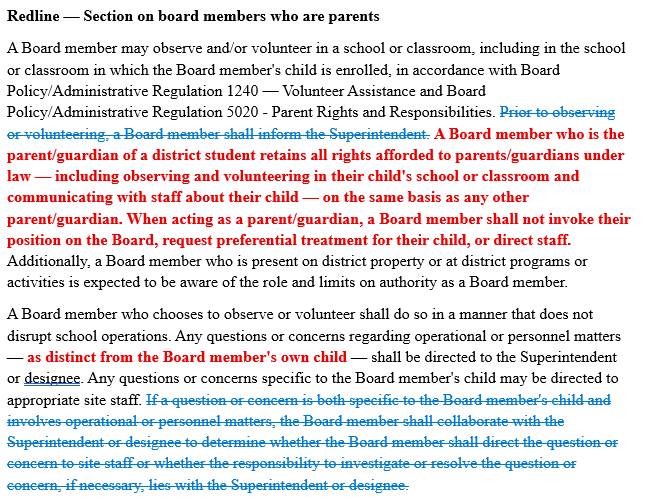
A Board member who is the parent/guardian of a district student retains all rights afforded to parents/guardians under law — including observing and volunteering in their child's school or classroom and communicating with staff about their child — on the same basis as any other parent/guardian. When acting as a parent/guardian, a Board member shall not invoke their position on the Board, request preferential treatment for their child, or direct staff. Matters concerning district operations or policy generally, as distinct from the Board member's own child, remain subject to the limits on individual Board member authority.
On listening to constituents: a member shouldn't investigate, direct, or decide — but should be able to understand your concern and follow up through the Superintendent to confirm policy was followed. I'm proposing:
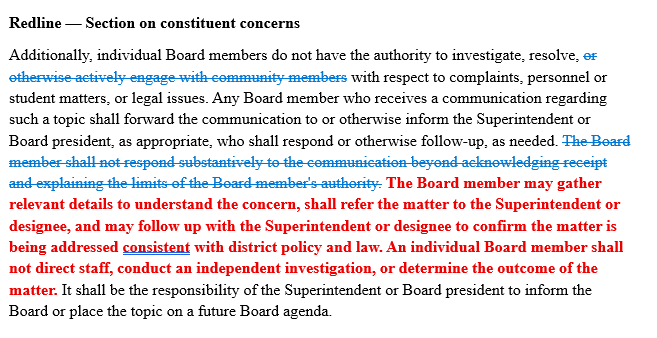
The Board member may gather relevant details to understand the concern, shall refer the matter to the Superintendent or designee, and may follow up with the Superintendent or designee to confirm the matter is being addressed consistent with district policy and law. An individual Board member shall not direct staff, conduct an independent investigation, or determine the outcome of the matter.
Below are the proposed redlines.
Rethinking the Digital Classroom: A Look at LAUSD’s "Using Technology with Intention" Policy
Cupertino Union School DistrictBackground
On April 21, 2026, the Los Angeles Unified School District (LAUSD) Board of Education unanimously approved a landmark resolution titled "Using Technology with Intention." This policy marks a significant pivot for the nation’s second-largest school district, transitioning from a "1:1 device" focus to a regulated model that prioritizes human interaction and developmentally appropriate screen limits.
The Evolution of the Digital Classroom
For districts like Cupertino Union (CUSD), 1:1 technology is not new. CUSD was an early adopter, implementing iPad programs in middle schools as far back as 2013. However, the 2020 pandemic served as a massive "accelerant," expanding 1:1 device programs down to the youngest elementary grades and normalizing a "digital-first" curriculum.
As LAUSD board members and a coalition of parents (known as Schools Beyond Screens) argued, while these tools were a necessary lifeline during school closures, their permanent, unregulated presence in classrooms post-pandemic has led to a "recalibration" crisis.
Key Provisions of the LAUSD Policy (Effective 2026-27)
- Total Ban for Youngest Learners: Students in Transitional Kindergarten (TK) through 1st Grade will no longer use district-issued digital devices for instruction, except for mandatory assessments.
- Mandatory Screen Time Caps: The district must establish maximum daily and weekly screen time limits for students in Grades 2–12, tailored by grade level and subject area.
- "Screen-Free" Social Times: Devices are prohibited during passing periods, lunch, and recess to encourage social development.
- Content Restrictions: A "hard block" on student-led use of YouTube and other streaming/gaming platforms on all district hardware.
- Return to Tactile Learning: The resolution explicitly encourages the use of "paper and pen" and the reprioritization of physical textbooks over digital-only curriculum.
The Scientific Basis
The LAUSD Board cited data from the American Academy of Pediatrics linking excessive screen use to increased anxiety, depression, and reduced attention spans. Board Member Nick Melvoin, the lead sponsor, noted that during the pandemic, screen-time limits were effectively "shelved," and the goal now is to restore balance.
Implications for CUSD
As a district that has navigated 1:1 technology for over a decade, CUSD is uniquely positioned to evaluate these changes. LAUSD’s move asks a question many Cupertino parents have raised for years: At what point does a powerful educational tool become a primary source of digital distraction?
Racial Preference in California? Understanding the Shift toward ACA 7
Cupertino Union School DistrictThe Constitutional "Wall"
For three decades, Proposition 209 has served as a constitutional "wall" in California. Passed by voters in 1996, it prevents school districts and government agencies from using race, gender, or ethnicity as a factor in admissions, hiring, or program placement. In 2020, California voters reaffirmed this principle by defeating Proposition 16, which sought a total repeal of those protections.
From Prop 16 to ACA 7
Following the defeat of Prop 16, proponents introduced ACA 7 with a more surgical approach. Unlike previous attempts at a total repeal, the current version (passed by the Assembly in February 2026) seeks to narrow the scope of the state’s equal treatment rules. It proposes to delete "public education" from the constitutional list of areas where racial and gender preferences are prohibited. While the bill adds a specific ban for "higher education admissions" to comply with U.S. Supreme Court rulings, it removes constitutional protection for the rest of the education system.
The K-12 and Resource Focus
By removing the broad "public education" category, ACA 7 effectively eliminates the equal treatment mandate for K-12 schools and university-level resource allocation (such as grants and specialized funding). This shift would grant school districts like CUSD the authority to once again use race, gender, or ethnicity as a factor in student acceleration, specialized enrollment, and the distribution of educational resources. This version ensures that while college admissions remain colorblind, the "pipeline" leading up to them—and the resources within them—can be legally managed through racial preferences.
Next Steps and Local Representation
The Assembly passed ACA 7 on February 19, 2026. Patrick Ahrens and Marc Berman, the Assemblymembers who represent the CUSD area, both voted "Yes" on the measure. The bill is now in the State Senate. Because it is a Constitutional Amendment, your State Senators (Josh Becker, Dave Cortese, and Aisha Wahab) will have the final say on whether this reaches your ballot for voter approval this November.
The 2023 California Math Framework: A Multi-Year Roadmap for Change
Cupertino Union School DistrictWhile the 2023 California Mathematics Framework (CMF) has been a topic of debate for several years, the state-level process reached a major milestone this past November. On November 6, 2025, the California State Board of Education officially approved a list of 64 instructional programs for K–8 and Algebra I that align with the new framework.
This marks the end of the state’s vetting process. The "adoption cycle" has now moved from the state level to individual school districts. While each district determines its own timeline for reviewing and adopting new materials—with many likely looking toward the 2027–2028 school year or beyond—the philosophies contained in these new state-approved books represent a significant shift in how math may be taught in the future.
The Goal: "Equity and Excellence" The California Department of Education (CDE) describes the new framework as a "Step Forward for Equity and Excellence." These terms represent the dual goals of the state’s vision:
- Equity: The goal of ensuring all students—regardless of background—have access to high-quality math and are not "tracked" out of advanced opportunities too early.
- Excellence: The goal of raising the bar for all students through deep problem-solving and data literacy, skills essential for a 21st-century workforce.
The "New Generation" of Math Philosophy: Trade-offs to Consider
The programs recently approved by the state represent a shift from traditional math instruction. Each pillar of this new philosophy carries potential benefits and common concerns that communities are currently weighing:
1. Active "Inquiry-Based" Learning
This shift moves away from the teacher providing a formula first. Instead, students "investigate" a complex task in groups to discover the logic themselves.
- Pros: Encourages "productive struggle" and deeper conceptual understanding. Proponents argue it makes math more joyful and relevant, which can reduce math anxiety and increase student engagement.
- Cons: Critics worry that without enough "Direct Instruction," students may fail to develop "automaticity" (speed and accuracy) with basic math facts. There is also concern that this method is less efficient, potentially leaving less time to cover the full curriculum.
2. Organization by "Big Ideas"
New textbooks group standards into 8–10 broad themes (e.g., "Data as a Tool" or "Patterns in the World") to show how math is interconnected across grades.
- Pros: Helps students see math as a unified language rather than a list of disconnected skills. It answers the common question, "When will I ever use this?" by placing math in a real-world context.
- Cons: Some educators fear this "integrated" approach can lead to a "fuzzier" curriculum where the mastery of discrete, rigorous skills—like factoring polynomials or long division—is glossed over in favor of broad concepts.
3. "Heterogeneous" (Mixed-Ability) Grouping
The framework encourages keeping students of all ability levels in the same classroom for longer (often called "de-tracking").
- Pros: Promotes equity by ensuring all students have access to high-quality content and prevents students from being "labeled" as low-achievers early in their education. It allows for peer-to-peer learning.
- Cons: Opponents argue that "one size does not fit all" and that mixed-ability classrooms can be extremely difficult for teachers to manage. There is concern that advanced learners may feel "held back" while struggling learners may feel overwhelmed without targeted, leveled support.
The Data Science vs. Calculus Debate
A core feature of the CMF is its emphasis on Data Science as a rigorous and relevant pathway. However, this has recently met with a significant policy shift from California's universities:
- The Framework’s Vision: To promote data literacy and statistics as a valid alternative to the traditional Calculus-focused track, making math more accessible to more students.
- The UC/CSU Reality: The University of California and California State University systems have clarified that Data Science courses no longer satisfy the "Area C" (Advanced Math) requirement in the same way Algebra II does. Students who take Data Science instead of Algebra II may find themselves ineligible for admission to these universities.
The 2026 "Study Phase"
Because the state-approved list of textbooks is now final, 2026 serves as an important "study phase." This period allows parents and community members to observe how these new instructional styles and "Big Ideas" align with local standards for academic rigor and student potential.
Understanding these state-level changes now ensures that as local districts eventually begin their own review processes in the coming years, the conversation is guided by a clear understanding of the options and trade-offs provided by the state.
Rebranding "Equity": The New Face of Grade Reform in the Tri-Valley
Cupertino Union School DistrictThe debate over how we grade our students is reaching a boiling point in the East Bay. What started as a controversial movement in San Francisco has now arrived in the Tri-Valley—but under a new set of names.
The SFUSD Precedent
In May 2025, the San Francisco Unified School District (SFUSD) attempted to mandate a district-wide "Grading for Equity" system. The proposal was met with fierce community opposition, leading the Superintendent to pull the plan. Critics argued the system lowered standards and reduced student accountability.
The Tri-Valley Shift (January 2026)
As of January 2026, school districts in Dublin, Livermore, Pleasanton, and San Ramon are actively considering or rolling out similar reforms. However, you won’t find the word “Equity” in many of the new proposals. Instead, administrators are using terms like:
- Standards-Based Grading
- Mastery-Based Assessment
- Grade Reform
The Architect: Joe Feldman
Behind these changes is Joe Feldman, author of Grading for Equity and the consultant who advised SFUSD. While Tri-Valley districts are using his framework, many are taking a "buffet" approach—adopting some of his methods while discarding others that proved too controversial.
For example, due to parent feedback, most local districts have abandoned the "50% minimum floor" (the practice where a student cannot receive lower than a 50%, even for missing work).
What is actually changing?
Proposed policies currently under review (including a major vote expected in SRVUSD between February and April 2026) include:
- Eliminating the +/-: An 89% becomes a B; a 91% becomes an A. This aims for "consistency" but has sparked debate among students worried about GPA impact.
- Redos and Retakes: Providing multiple opportunities for students to demonstrate mastery of a subject.
- Separating Behavior from Academics: Eliminating "participation points" or "extra credit" for bringing in classroom supplies, ensuring the grade reflects only what the student has learned.
- Softening Deadlines: Encouraging teachers to reduce or eliminate point deductions for late work.
Why the Rebrand?
Officials state that terms like "Mastery-Based" better describe the goal: ensuring every student actually learns the material. Critics, however, argue that "Mastering-Based" is simply a rebranding of "Equity Grading" designed to bypass the same community pushback that happened in San Francisco.
What do you think?
Does removing the +/- scale make grading fairer, or does it hurt high-achieving students? Is "Mastery" a better goal than "Accountability"?
Student Privacy vs. Parental Rights
Cupertino Union School DistrictOn December 22, 2025, a federal district court issued a significant ruling in the case of Mirabelli v. Olson. The judge granted a class-wide permanent injunction against the State of California, fundamentally altering how schools handle student information regarding gender identity and medical privacy.
The Court's Key Findings
The ruling centers on the tension between state privacy mandates and federal constitutional protections. The court reached three primary conclusions:
- Parental Rights: Under the 14th Amendment, parents have a "fundamental right" to be informed of significant issues affecting their child's health and well-being.
- Teacher Rights: Forcing school staff to withhold information or provide misleading answers to parents violates the teachers' First Amendment rights to free speech and religious exercise.
- Supremacy of Federal Law: The court mandated that school training materials must now explicitly state that federal constitutional rights to parental notification are superior to any conflicting state or local laws.
The Core Conflict: Autonomy vs. Guardianship
This ruling highlights a deep legal and ethical divide:
The State's Position: California emphasizes that minors are individuals with an independent right to privacy. The state argues that confidentiality is necessary to protect students who may face a hostile environment at home.
The Federal Court's Position: The court asserts that because minors are not yet fully mature, they require the guidance of their parents. Therefore, a parent's right to oversee their child's upbringing outweighs the school's interest in maintaining secrecy.
Beyond Gender Identity: Implications for Reproductive Health
While Mirabelli v. Olson specifically addressed "social transitions" (name and pronoun changes), the legal logic may extend to other confidential services. Currently, California Education Code § 46010.1 allows schools to excuse students for "confidential medical services" -- including abortion and reproductive care -- without parental consent or notification.
The following table illustrates the current legal landscape following the injunction:
Topic Pre-Mirabelli Status Post-Mirabelli (Current) Gender Identity Schools were required to keep transitions confidential from parents. Schools are forbidden from requiring secrecy, teachers may inform parents. Reproductive Health Strictly confidential under EdCode § 46010.1. The Statue remains, but the ruling creates a precedent that parental rights may override this state law.What's Next?
The ruling in Mirabelli v. Olson is not yet the final word. The State of California is expected to appeal the decision to the Ninth Circuit Court of Appeals. Legal experts view this as a "test case" that is likely to be petitioned to the U.S. Supreme Court to establish a national standard for parental rights in education.
CUSD Fiscal Stabilization Plan
Cupertino Union School DistrictOverview
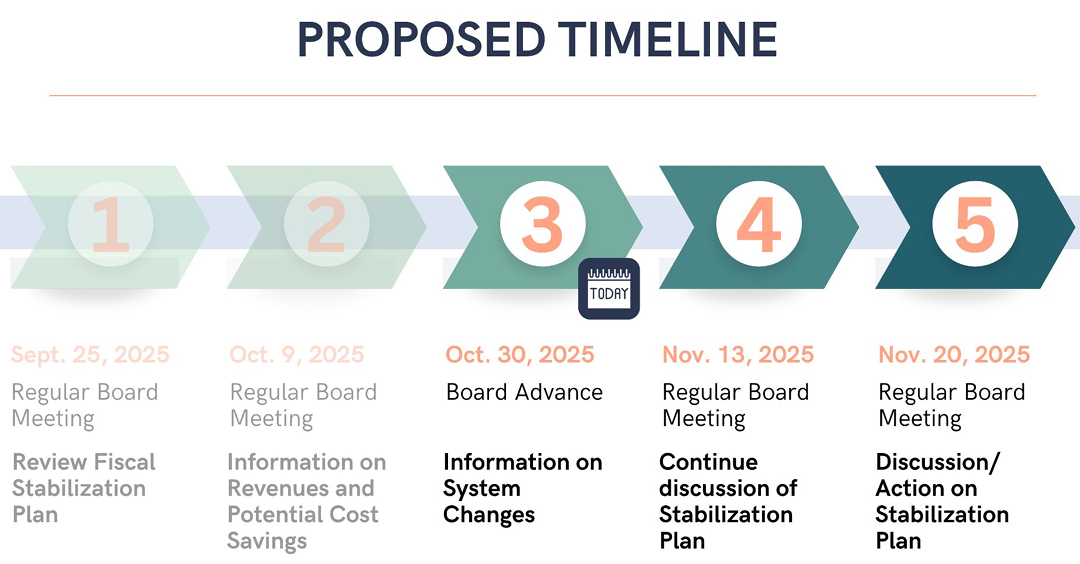
The Cupertino Union School District (CUSD) is addressing ongoing budget challenges through a fiscal stabilization plan. This initiative aims to reduce deficits proactively, maintain adequate reserves, and minimize impacts on educational programs. The following provides background on the current fiscal situation and proposals discussed at the October 30, 2025, Board Advance meeting.
Current Fiscal Context
CUSD faces pressures from declining enrollment, lost local revenues, and external funding uncertainties:
Deficits: Fiscal Year (FY) 2024-2025 closed with a deficit exceeding $26 million. FY 2025-2026 projections indicate a shortfall of more than $11 million.
Reserves: Board-designated reserves are expected to drop below 5% of the annual budget, compared to the district's 10% target. Neighboring districts often maintain around 20% reserves for added stability.
Revenue Loss: The district has lost approximately $8 million annually from the expired parcel tax since 2024.
Broader Factors: Federal cuts and state budget volatility, including Local Control Funding Formula (LCFF) adjustments, exacerbate challenges for Basic Aid districts like CUSD.
These trends underscore the need for targeted efficiencies to avoid larger program reductions in the future.
Board Advance Discussion: Targeted Reductions
District staff presented a plan for $8 million in savings, focusing on:
Middle school elective offerings
Transitional Kindergarten (TK) adjustments
Early retirement incentives
Cuperdoodle program changes
Emphasis is on middle school electives and TK, potentially yielding $4–5 million combined. Details follow.
Middle School Electives
Electives such as band, foreign languages, woodshop, and photography support student engagement. Recent changes include:
Pre-2025: Offerings varied by school (e.g., two electives for 7th/8th graders at some sites, one for 6th graders).
FY 2025-2026: Expansion to two electives for all 6th–8th graders, enabled by enrollment declines without new hires.
With continued enrollment at lower levels, proposed options balance access and costs:
Option 1: 7th/8th graders may opt for a second elective; 6th graders receive one. Projected impact: ~18 full-time employees (FTEs) reduction in middle school staff. Estimated savings: ~$2.1 million.
Option 2: All 7th/8th graders receive two electives; 6th graders receive one. Projected impact: ~13 FTEs reduction. Estimated savings: ~$1.5 million.
Option 3 (Status Quo): All 6th–8th graders receive two electives, accounting for enrollment declines. Projected impact: Minimal staff changes. Estimated savings: ~$0.6 million.
Option 4: All 6th–8th graders may opt for a second elective (voluntary). Projected impact: Savings pending analysis; aligns staffing with participation. Estimated savings: To be determined.
All options ensure at least one elective per student.
Transitional Kindergarten (TK)
TK, a statewide pre-K program for four-year-olds, aids kindergarten readiness but poses funding issues for Basic Aid districts:
- No state funding per TK student (vs. ~$5,545 extra for LCFF districts).
- Mandated 1:10 adult-to-pupil ratio (vs. 1:20 or more for other grades), nearly doubling per-pupil costs.
Serving ~720 students currently, proposed adjustments include:
Option 1: Half-day classes; no enrollment cap. Projected impact: TK teachers and instructional assistants (IAs) reduced to 60% contracts. Estimated savings: ~$2.5 million.
Option 2: Full-day classes; cap enrollment at 360 students. Projected impact: ~36 teacher/IA positions eliminated. Estimated savings: ~$3.2 million.
Option 3: Split-day classes (e.g., alternating schedules). Projected impact: ~36 teacher/IA positions eliminated. Estimated savings: ~$2.5 million.
These maintain significant TK capacity while reallocating resources to K–8 priorities.
Next Steps
The board will review and vote on the stabilization plan at the board meeting on 11/20/2025.
Teachers Fired for Speech: Recent Cases and Implications
Cupertino Union School DistrictIn recent years, several teachers have been terminated for expressions related to social or political topics, either in the classroom or on personal social media. These incidents span diverse viewpoints and have fueled ongoing discussions about free speech protections for public educators versus institutional expectations for neutrality. The following examples outline key details from three such cases.
2023, St. Philip's College, Texas: Adjunct biology professor Johnson Varkey was fired after stating in class that biological sex is determined by X and Y chromosomes, prompting student complaints of discrimination and walkouts. He was reinstated following a settlement with the college. Link
2023, Jurupa Unified School District, California: Tenured PE teacher Jessica Tapia was terminated for declining to use students' preferred pronouns and for not disclosing students' gender transitions to parents, citing her religious beliefs. The district reached a $360,000 settlement with her in 2024. Link
2025, Jourdanton High School, Texas: Social studies teacher Matthew Justin Holland was placed on administrative leave and later unanimously fired by the school board after a social media post about the assassination of conservative activist Charlie Kirk on September 10, 2025, gained widespread attention. The post was made outside school hours. Link
In two of these cases, the initial terminations were followed by settlements or reinstatements, while the third proceeded to final termination. Such outcomes highlight varying approaches to handling teacher speech, particularly when it occurs off-campus. These situations prompt consideration of several issues in educational policy and employment:
To what extent should school districts regulate teachers' expressions made outside of work?
How do district guidelines align with legal protections for free speech and personal beliefs?
In what ways do public reactions influence decisions about employee conduct?
These cases contribute to wider conversations on the boundaries of expression in public schools.
In response to Texas’s 2025 mid-decade redistricting plan, which aims to add five Republican-leaning congressional seats, California Governor Gavin Newsom has proposed Proposition 50 to redraw California’s congressional districts to favor Democrats, offsetting potential losses in Congress. This proposal, driven by the Democratic supermajority in the state legislature, seeks to temporarily transfer redistricting authority from the California Citizens Redistricting Commission (CRC) to the legislature for the 2026, 2028, and 2030 elections.
Legal Context and Constitutional Changes
Under the California Constitution, the CRC, an independent 14-member body established by Proposition 11 (2008) and Proposition 20 (2010), is responsible for redrawing congressional and state legislative districts every decade following the federal census. Mid-decade redistricting is prohibited unless ordered by a court, as clarified in Legislature v. Deukmejian (1983). To enable Proposition 50, two constitutional amendments are proposed:
- Transferring redistricting power from the CRC to the state legislature for congressional maps until 2030.
- Allowing mid-decade redistricting without a court order.
The state Assembly and Senate passed these amendments with a two-thirds supermajority in August 2025. Proposition 50 now requires approval by more than 50% of California voters in a special election on November 4, 2025, to take effect.
Controversy and Public Response
Proposition 50 has sparked significant debate. Supporters, including Governor Newsom, argue it’s a necessary countermeasure to Texas’s redistricting, which passed the Texas House on August 20, 2025, to strengthen Republican control of Congress. They view it as protecting California’s interests in a national “redistricting war.” Opponents, including the California Republican Party and former Governor Arnold Schwarzenegger, contend it undermines the CRC’s nonpartisan process, risking partisan gerrymandering and eroding voter trust.
A recent controversy involved a flyer from the Voters First Act, which quoted the League of Women Voters of California’s president opposing mid-decade redistricting. The League distanced itself from the flyer on its website but reaffirmed its opposition to mid-decade redistricting, advocating for independent and transparent redistricting processes.
Implications for California
Proposition 50 could reshape California’s congressional representation, potentially affecting federal funding and policies that impact education, including in districts like Cupertino Union School District (CUSD). With 45% of California children having at least one immigrant parent, fair representation is critical for communities with diverse needs. The outcome of the November 4, 2025, election will determine whether California adopts this unprecedented mid-decade redistricting approach.
LGBTQ Content and Parents' Rights in Schools
Cupertino Union School DistrictIn June 2025, the Supreme Court issued a preliminary injunction in Mahmoud v. Taylor, affirming parents' rights to opt their children out of LGBTQ-themed instructional materials in schools, citing the First Amendment's free exercise of religion clause. This ruling applies nationwide, impacting all U.S. school districts, including the Cupertino Union School District (CUSD).
Implications for CUSD
The decision requires CUSD to take specific actions to comply with federal law and respect parental rights:
- Develop clear opt-out processes for parents to exempt their children from LGBTQ-related materials
- Provide teacher training and guidelines on handling LGBTQ-themed content sensitively and compliance with the ruling
- Review board policies to ensure alignment with the Supreme Court's decision and other legal requirements
In CUSD, the Opening Day Packet includes language below in E.8 under Curriculum and Instruction:
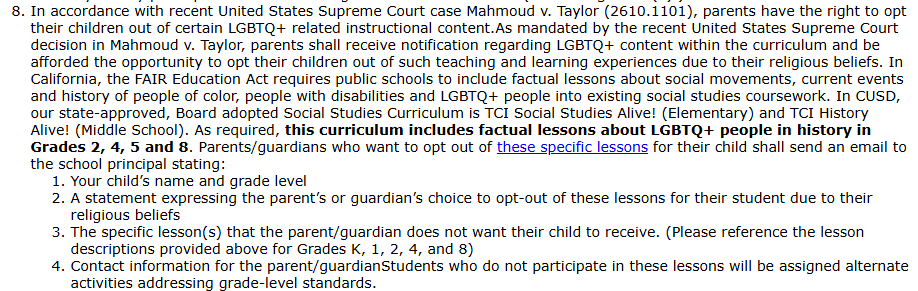
Community Concerns and Context
Before my election to the CUSD board, some parents raised concerns at board meetings about the use of LGBTQ-related books and content in classrooms. The Mahmoud v. Taylor ruling, grounded in religious freedom, highlights the need to examine not only LGBTQ content but also other materials that may conflict with religious beliefs. For example, the Santa Clara County Office of Education recently encouraged schools to display posters promoting inclusivity, which some view as conflicting with certain religious values.

Balancing Inclusion and Religious Sensitivities
The Supreme Court's decision prompts us to consider educational content that may intersect with religious beliefs. Potential areas of concern include:
- Stories featuring animals considered impure in some faiths (e.g. Peppa Pig for some Muslims)
- Evolution theory in science curricula, which may conflict with literal interpretations in some Christian or Islamic traditions
- Lessons on gender identity or LGBTQ+ issues, which may raise concerns for some religious families
- Celebrations of holidays like Halloween or Christmas, potentially seen as non-inclusive by many families.
- Literature involving magic, such as Harry Potter, which some religious groups associate with occult practices
- Activities involving non-kosher foods, which may conflict with Jewish dietary laws
- Historical discussions, like the mistreatment of Alan Turing, a renowned mathematician and computer scientist, for his homosexuality, which may spark debate in some religious communities
- Science lessons asserting the Earth is round, which may conflict with rare flat Earth beliefs
- Lessons on the science of electronics, which may be sensitive for communities like the Amish who limit technology use to preserve religious values
Opt-In or Opt-Out
CUSD plans to include an opt-out form in the Opening Day Packet, allowing parents to exempt their children from LGBTQ-themed instructional materials. If parents fail to return the form, their children will participate in this instruction.
In contrast, the Howell Mountain School District in Napa County is considering an opt-in form. If parents do not return the opt-in form, their children will not participate in LGBTQ-themed instruction.
What are your thoughts on the best approach for CUSD?
Fostering a Sense of Belonging
At CUSD, creating a sense of belonging for all students is a priority. How do we balance inclusivity with respect for diverse religious and cultural values? The Mahmoud v. Taylor ruling invites us to explore this question, ensuring every student and family feels respected while maintaining high-quality education.
SFUSD’s Equity Grading Proposal Sparks Debate
Cupertino Union School DistrictIn May 2025, the San Francisco Unified School District (SFUSD) superintendent proposed an equity grading system for 14 high schools, bypassing school board approval. After swift backlash, the plan was canceled, but it raises questions about grading fairness and educational quality.
What Is Equity Grading?
The proposed system aimed to simplify grading and reduce disparities. Key features included:
- Wider grade ranges: On a 100-point scale, grades were assigned every 20 points (e.g., 80+ for A, 60–79 for B, 40–59 for C, 20–39 for D, below 20 for F), compared to traditional 10-point increments (90+ for A, 80–89 for B, etc.).
- Final exam focus: Grades depended solely on a final exam, which students could retake multiple times, excluding factors like homework or attendance.
Proponents argued this would reduce stress and promote equity by leveling the playing field. Critics, however, warned it could inflate grades and lower academic rigor.
Impact on Students and College Admissions
Equity grading could significantly boost students’ Grade Point Averages (GPAs), a critical factor in college admissions, especially in California, where the University of California system no longer considers SAT or ACT scores. Higher GPAs might give SFUSD students an edge, but colleges could adjust evaluations if grade inflation is widespread. How would this reshape admissions fairness?
Does Equity Grading Support Quality Education?
As a CUSD board member, I believe our district’s primary goal is to provide high-quality education. Critics of SFUSD’s equity grading argue it may prioritize equal outcomes over academic mastery, potentially undermining rigor. Supporters counter that it addresses systemic barriers, enabling more students to succeed. This debate prompts us to examine what “equity” means in education and whether it aligns with delivering excellence.
Relevance to CUSD
In the Cupertino Union School District (CUSD), we prioritize personalized learning, offering differentiated pathways like math tracking in middle school. SFUSD’s proposal encourages us to reflect: Should we consider alternative grading models, or continue emphasizing tailored education?
PAUSD’s Biology Course Merger Sparks Debate on Equity and Excellence
Cupertino Union School DistrictOn January 21, 2025, the Palo Alto Unified School District (PAUSD) board voted 3-2 to merge its 9th-grade Biology Honors and standard biology courses into a single curriculum, a process known as de-tracking. This decision has ignited significant debate, drawing both local and national attention.
A Push for Equity
PAUSD cited equity as a key rationale for the change. By offering one biology course, the district aims to “reduce stigma and labels” and foster “inclusion and diversity,” ensuring all students receive the same foundational education. Supporters argue this approach promotes fairness and equal opportunities for learning.
Criticism and Concerns
The decision has faced pushback. Local U.S. Representative Ro Khanna called it “absurd” and an “assault on excellence,” arguing that eliminating honors courses could undermine academic rigor for high-achieving students. Critics question whether a unified curriculum can meet the diverse needs of all learners without compromising advanced instruction.
DEI in Education
Cupertino Union School DistrictIn a recent directive, the Trump Administration has mandated that all U.S. schools and universities eliminate their Diversity, Equity, and Inclusion (DEI) programs, threatening the loss of federal funding for noncompliance. Additionally, the administration has launched investigations into the admissions policies of Stanford University, UC Berkeley, UCLA, and UC Irvine, targeting what it describes as "race-based preferences" in an effort to enforce anti-DEI policies.
What is DEI?
DEI stands for Diversity, Equity, and Inclusion. These initiatives aim to promote opportunities for historically disadvantaged groups by addressing systemic barriers in education, employment, and other sectors. Proponents argue that DEI fosters fairness and broadens access, while critics contend that it can lead to preferential treatment for some groups and disadvantage others.
DEI and California Law
California’s stance on race and equity in public institutions is shaped by Proposition 209, passed in 1996. This measure amended the state constitution to prohibit public entities—including schools, universities, and government agencies—from considering race, sex, or ethnicity in public employment, contracting, and education. In 2020, Proposition 16 sought to repeal Prop 209 and restore the ability to use such factors, but voters rejected it. As a result, California’s public institutions remain legally barred from implementing race-, sex-, or ethnicity-based preferences.
The Trump Administration’s recent investigations into Stanford, UC Berkeley, UCLA, and UC Irvine signal a determined effort to uncover whether these universities are quietly defying California’s strict ban on race-based preferences in admissions. Despite the state constitution—via Proposition 209—explicitly prohibiting such practices, the administration suspects these institutions may be secretly favoring certain racial groups, and it has threatened to cut federal funding if evidence of these hidden “race-based preferences” comes to light.
Cupertino Union School District’s Position
The Cupertino Union School District (CUSD) does not currently operate formal DEI programs. Given this, and California’s existing legal framework under Prop 209, CUSD appears unlikely to be directly impacted by the administration’s anti-DEI measures or funding threats.
DEI in College Admissions and Workplace Hiring
The debate over DEI extends to college admissions and workplace hiring, where DEI initiatives can sometimes conflict with purely merit-based approaches. DEI-focused policies often aim to balance representation across factors like gender, race, or other identities, emphasizing systemic equity. In contrast, merit-based systems prioritize individual qualifications, such as academic achievements or professional skills, without regard to demographic characteristics. Both approaches spark discussion: DEI advocates highlight the need to address historical inequities, while merit-based proponents argue for evaluating candidates solely on their abilities.
These approaches reflect distinct philosophies. DEI policies often group individuals by identity categories to achieve balanced representation across diverse groups. Merit-based policies, however, focus on treating each candidate as an individual, emphasizing their unique qualifications and contributions without reference to group identity. Both perspectives fuel ongoing discussions about fairness, opportunity, and the best path to equitable outcomes.
By-Trustee-Area Election in CUSD?
Cupertino Union School DistrictThe California Voting Rights Act (CVRA) of 2001 aims to prevent the dilution of minority voting power in at-large election systems. Unlike federal voting rights laws, the CVRA lowers the bar for minority groups to challenge governments using at-large elections, often prompting cities and school districts to switch to by-trustee-area elections to avoid costly litigation.
At-Large vs. By-Trustee-Area Elections
- At-Large Elections: All voters in a district elect every trustee, regardless of where they live within the district. The Cupertino Union School District (CUSD) currently uses this system.
- By-Trustee-Area Elections: The district is divided into separate geographic areas, each electing its own trustee. Voters cast ballots only for the trustee representing their specific area.
Recent Transitions in Neighboring Districts
- In 2024, the Fremont Union High School District, which encompasses the entire area of CUSD, shifted from at-large to by-trustee-area elections, sparking lively debate among local residents.
- Similarly, the Mountain View Los Altos High School District began transitioning to by-trustee-area elections in 2024, with the process still underway as of February 2025.
These changes highlight a growing trend in the region.
What Triggers a Transition
The shift to by-trustee-area elections often begins with a demand letter from an attorney citing the CVRA. Under the law, plaintiffs don't need to prove that a minority group is concentrated enough in a specific area to form a majority, giving them a legal edge. However, districts can resist the change if they demonstrate that no such concentration exists. For instance, the Palo Alto Unified School District received a demand letter but successfully argued that its minority populations were not sufficiently concentrated to justify by-trustee-areas, allowing it to retain at-large elections.
Potential Benefits and Drawbacks of By-Trustee-Area Elections
Benefits:
- Candidates campaign in smaller areas, making it easier to connect with voters.
- Campaign costs are typically lower due to the reduced geographic scope.
- Each major area of the district gains its own representative, which some view as fairer geographic representation.
Drawbacks
- CUSD might lack strong evidence that a minority group's voting power is significantly diminished by at-large elections, weakening the legal case for a change.
- Voter influence is reduced: In a five-trustee district with four-year terms, voters currently elect all five trustees over four years under at-large elections, but with by-trustee-area elections, they'd vote for only one trustee in that time.
- Trustees might prioritize their area's needs over the district's broader interests, potentially fragmenting decision-making.
Looking Ahead
By-trustee-area elections offer a potential path toward localized representation, but they also raise questions about voter influence and district unity. As CUSD considers its options -- possibly in response to a future attorney letter -- the trade-offs between these systems remain a critical topic for community discussion.
CUSD Property Matters
Cupertino Union School DistrictDistrict staff presented on CUSD property matters at the board advance meeting on January 23, 2025. The presentation can be found here.
Current Property Conditions
Below is the screenshot for property current conditions.
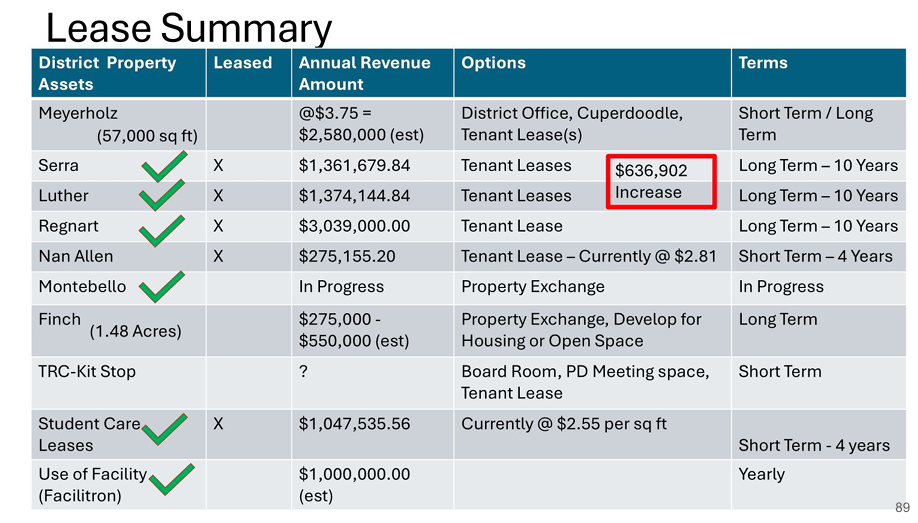
Options for Meyerholz and Finch
Meyerholz Elementary School:
- Meyerholz Elementary School, which was closed (see here for more detail), currently houses Cuperdoodle, a district-run preschool, utilizing the portable structures of Meyerholz. For more details, see here.
Finch Property:
- The Finch property is a 1.48-acre vacant lot purchased by the district around 2017. The house on the property was removed, and the contaminated soil was cleaned up. It is currently zoned R1-6, indicating single-family homes with a minimum 6,000-square-foot lot.
Finch Property Options During the meeting, several options for the Finch property were discussed:
- Central Kitchen
- District Educational or Recreation needs
- City needs
- Revenue generation
The first two options were briefly mentioned with high cost/maintenance. The option for city needs remains undecided due to a lack of formal communication with the City of Cupertino.
Potential revenue options: The consultant presented three potential revenue generation options.
- Senior Project:. Estimated value range is $5.5M - $6.5M, but this option was ruled out due to the site's unsuitability for a senior project.
- Single Family Project: Estimated value range is $9M - $10M.
- Townhome Project. Estimated value range is $10M - 11M. Please notice it would be up to developer to change the zoning.
The consultant advised that the district should not act as the developer. The recommended approach involves:
- Selling the property to a developer with a plan
- Purchasing another commercial property to generate rental revenue.
These steps can be combined to appear as an "exchange" to the district.
However, several questions require further exploration:
- Do we need to sell the Finch property? Keeping it vacant incurs maintenance costs, and the government might begin charging property taxes.
- If we sell the Finch property, should we exchange it for a commercial property?
(Disclaimer: this article is NOT investment advice.) According to investopedia, the S&P 500 index has significantly outperformed real estate over the last 50 years. Also,
- The index comprises 500 top companies, offering more diversification and lower risk than specific real estate investments.
- The index ETF also provides quarterly dividends, offering the district a cash flow as well.
- Additionally, the index ETF is a "buy and hold" investment, eliminating the need for property management, tenant acquisition, and concerns about natural disasters.
If we do it right, CUSD probably might never need to issue more bonds 50 years later.
Meyerholz Options
Currently, Cuperdoodle occupies the portables at Meyerholz. There are two rental options for Meyerholz: with or without the portables. Renting all buildings would generate more rental income, but the district would need to find a new site for Cuperdoodle if all buildings are rended out.