Proposed changes to Board Policy 9200 — "Limits of Board Member Authority"
-
Posted by Long Jiao, CUSD Board of Education. I'm sharing this so our community can weigh in before the Board votes this summer. The background below is meant to lay out the change fairly; my own view is in a clearly marked section at the end.
What BP 9200 is
Board Bylaw 9200 defines what an individual board member can and cannot do. The core principle is long-standing: a school board acts as a unit, and a single member does not run the district, direct staff, or speak for the Board on their own. The California School Boards Association (CSBA) has recommended updates to this bylaw (along with several others). These are model recommendations — the Board may adopt, modify, or decline them.
What's being proposed
See the redline here.
- Board members who are parents in the district.
- Current: a board member "should inform the Superintendent or designee before volunteering in his/her child's classroom."
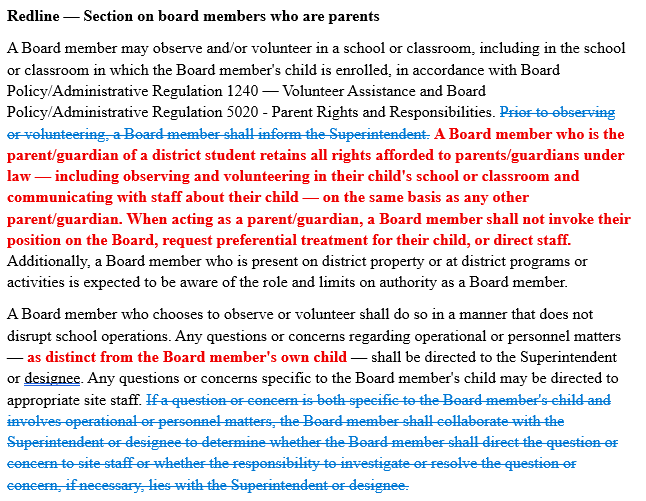
- Proposed: "Prior to observing or volunteering, a Board member shall inform the Superintendent," and for a concern that is "both specific to the Board member's child and involves operational or personnel matters," the member "shall collaborate with the Superintendent… to determine whether" they may take it to site staff.
- Stated rationale: a board member's presence can unintentionally pressure school staff, and the district has an interest in preventing any appearance of preferential treatment for a member's own child.
- How members handle constituent concerns.
- Current: "Individual Board members do not have the authority to resolve complaints. Any Board member approached directly by a person with a complaint should refer the complainant to the Superintendent or designee so that the problem may receive proper consideration and be handled through the appropriate district process." (A member may not resolve a complaint and should refer the person to the Superintendent — but the current text does not restrict listening to or discussing the concern.)
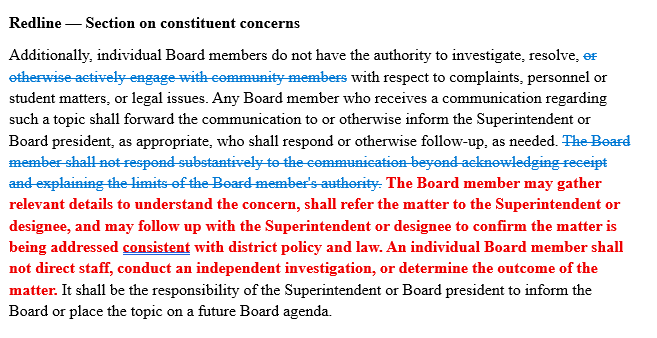
- Proposed: individual members have "no authority to investigate, resolve, or otherwise actively engage with community members" on complaints, personnel, student, or legal matters, and "shall not respond substantively… beyond acknowledging receipt and explaining the limits of the Board member's authority." A member may still engage on "general inquiries or expressions of opinion."
- Stated rationale: keep the Board acting as a unit, route matters through the Superintendent, and avoid individual members investigating or directing staff.
Considerations on each side
In favor of the changes: clearer guardrails; protects school staff from feeling pressured by a board member; reduces the risk (or appearance) of special treatment; reinforces that the board acts collectively and that operations run through the Superintendent.
Concerns raised about the changes: they may reach beyond those guardrails. State law (Education Code 51101) gives every parent the right to be involved in their child's education, and the bylaw itself says that right "is not affected upon election to the Board" — yet the new requirements (notify first; get sign-off to raise certain concerns about your own child) do affect it. On constituent concerns, barring a member from responding "substantively… beyond acknowledging receipt" could prevent even understanding an issue or following up on whether policy was followed — which is closer to representation and oversight than to "administrative authority."
My view and what I'm proposing
(This section is my personal opinion as a board member.)
I support the principles here — the board acts as a unit, members shouldn't direct staff or seek special treatment. My concern is that the new language overshoots on two points, and I plan to propose amendments.
On parents who serve: I don't believe serving on the board should shrink your rights as a parent. The real risk — using your office as leverage — is better addressed directly than by making a parent ask permission to help in their own child's classroom. I'm proposing:
A Board member who is the parent/guardian of a district student retains all rights afforded to parents/guardians under law — including observing and volunteering in their child's school or classroom and communicating with staff about their child — on the same basis as any other parent/guardian. When acting as a parent/guardian, a Board member shall not invoke their position on the Board, request preferential treatment for their child, or direct staff. Matters concerning district operations or policy generally, as distinct from the Board member's own child, remain subject to the limits on individual Board member authority.
On listening to constituents: a member shouldn't investigate, direct, or decide — but should be able to understand your concern and follow up through the Superintendent to confirm policy was followed. I'm proposing:
The Board member may gather relevant details to understand the concern, shall refer the matter to the Superintendent or designee, and may follow up with the Superintendent or designee to confirm the matter is being addressed consistent with district policy and law. An individual Board member shall not direct staff, conduct an independent investigation, or determine the outcome of the matter.
Below are the proposed redlines.