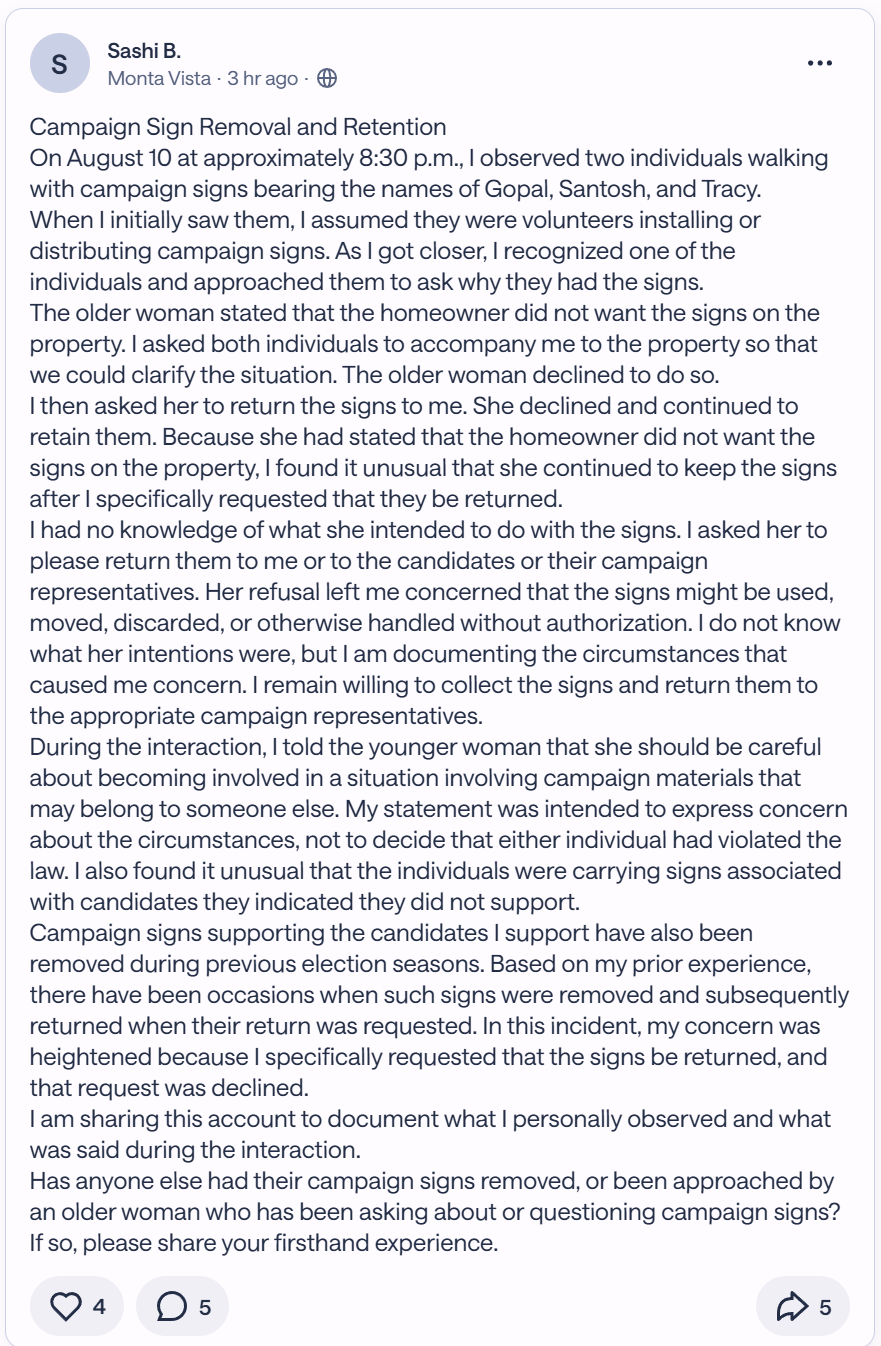
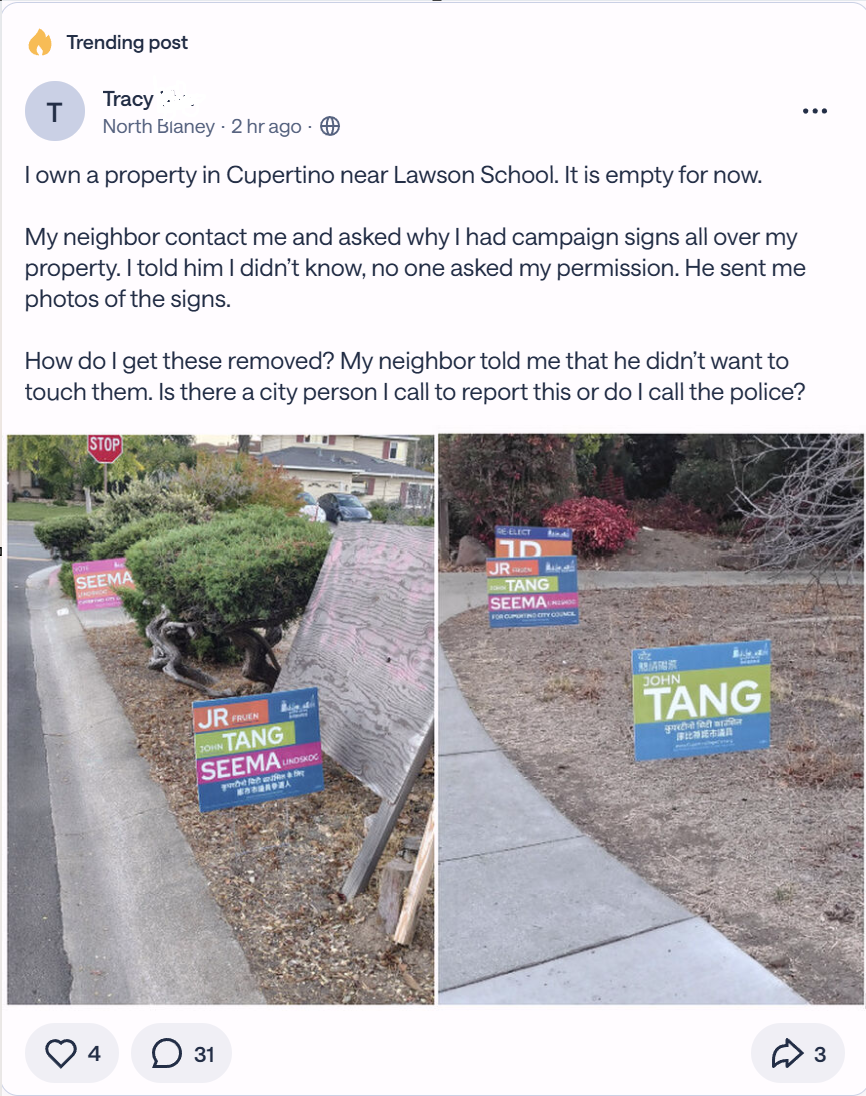
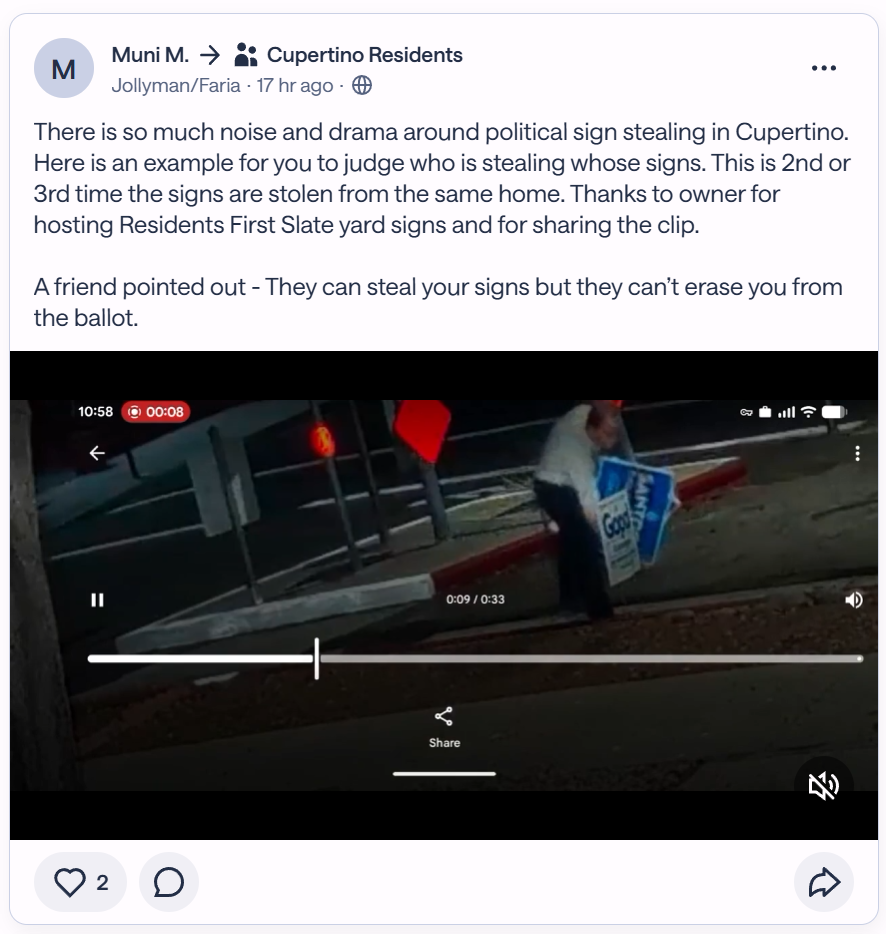
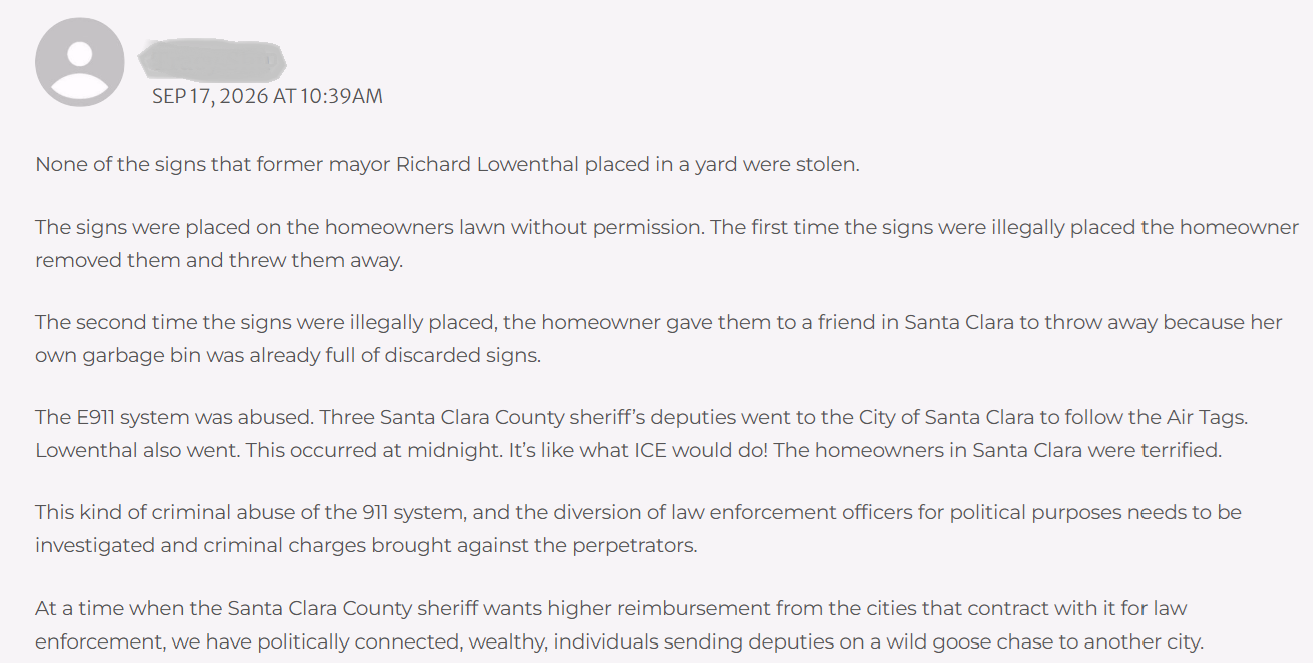
At the September 1 Cupertino City Council meeting, several residents used the public-comment period to raise concerns about campaign signs — describing signs being removed or damaged, signs placed on their property without permission, and, in one account, a candidate misrepresenting a neighbor's support. You can watch the public comments in the city's meeting recording. It's worth stepping back from any single race to talk about why this keeps happening — and what your rights as a resident actually are.
It's campaign season in Cupertino, and — as in many election years — residents are again reporting campaign signs being pulled, damaged, or placed where they don't belong. It's easy to shrug off a missing lawn sign as small-time mischief. I'd like to make the case that it isn't, and that how we treat each other's signs says something about the health of our local democracy.
A personal note. When I ran for the Cupertino Union School District board in 2024, one of my volunteers went out one morning to check on our signs and found several of them pulled out of the ground and left lying on the lawn. What bothered me wasn't the cost of a sign — it was the message it sent: that someone had decided the people who'd volunteered their time and put their names behind a campaign didn't deserve to be heard. That's exactly why I care about this as a civic issue rather than a partisan one. It's wrong when it happens to anyone.
This isn't new, and it isn't isolated. Santa Clara County has been here before. During the competitive 2022 San Jose mayoral race, candidates reported hundreds of yard signs stolen across several races (CBS News). And it isn't always malicious: earlier this cycle, Cupertino public-works crews mistakenly removed and discarded more than a dozen City Council candidates' signs along Bollinger Road during a routine traffic-safety sweep — the city acknowledged the error and agreed to reimburse those affected (San José Spotlight; Cupertino Patch). Whether it's theft, vandalism, or a good-faith mistake, the effect is the same: someone's political speech vanishes from public view.
When it's deliberate, it's often a crime. Under California law, taking or defacing someone's campaign signs can be prosecuted as petty theft, vandalism, or trespassing, and the state has specific statutory protections for political signs (overview from a California election-law firm; AB 362, "Political signs: theft and damage"). A sign is cheap; interfering with someone's speech is not a trivial thing.
But it genuinely cuts both ways. The problem isn't only signs being removed — it's also signs being placed, on private property or in public spaces, without permission. Both undermine the same thing: a fair process where each candidate's message rises or falls on its own merits, not on who's willing to bend the rules after dark. And nowhere is that clearer than in the one spot people argue about most.
A local example: the "park strip." You don't have to take my word for where the line falls — Cupertino's code draws it. The park strip (the city's own term for the landscaped strip between the sidewalk and the street) is governed by Cupertino Municipal Code § 19.104.250. For political signs the rules are simple: no permit, four square feet or less, down within five days after the election. But one line does the real work. In the public right-of-way, a political sign is —
"Within the public right-of-way — only allowed in the park strip in residential areas with authorization from the immediately adjacent property owner or resident."
Read that twice, because it settles a lot of arguments. In Cupertino, a campaign sign on the park strip is permitted only if the adjacent resident has said yes. A sign staked into someone's strip without asking isn't a gray area — it's simply not allowed. And that reframes the fight over "who pulled whose sign": there's a real difference between a resident removing an unauthorized sign from the strip in front of their own home, and someone stealing a sign out of a private front yard. In the heat of a campaign the two get lumped together, but they aren't the same thing — and the code is what lets us tell them apart.
What to do about a sign that shouldn't be there: the city's process. If a sign turns up on your park strip or your property without your okay, you're not stuck with it — and you don't have to get into a confrontation over it. It helps to know which of the two you're dealing with, because your private property and the public right-of-way meet somewhere in your front yard. The right-of-way usually includes the park strip (between the sidewalk and the street).
Either way, you don't have to leave a sign you never approved. If it's on your private property, an uninvited sign is a trespass on land that's yours, and you can simply take it down. If it's on the park strip (public right-of-way), it isn't "trespassing" on your private property — but under Cupertino Municipal Code it still can't be there without your permission (§ 19.104.250), and the code spells out the remedy directly:
§ 19.104.340(C): "Any political sign placed in a park strip within the public right-of-way in residential zones, without the consent of the adjacent property owner or resident, may be removed and discarded by that adjacent property owner or resident."
So if an unauthorized sign appears next to your home, the city gives you two options:
Remove it yourself. Under § 19.104.340(C) you may take down — and even discard — a sign placed on your adjacent park strip without your consent. Choose this and the matter is closed.
File a code enforcement complaint with Cupertino and let the city handle it. You can file a code enforcement complaint by calling (408) 777-3182 and leaving a voice mail with your name, number, address and a clear complaint or by sending email to code@cupertino.gov. You can also download the Cupertino 311 Mobile app and file a code enforcement complaint via the app. Code Enforcement contacts the candidate(s) and gives a 2-business-day notice to remove the sign; if they don't, city staff removes it. Removed signs are held for a period during which the owner can retrieve them (for a fee), and unclaimed signs are eventually disposed of.
Either way, the point is the same: there's a calm, lawful path. You don't have to argue with a canvasser or a neighbor, and you don't have to let a sign you never approved stand in front of your home.
Why it matters. A yard sign is a small but real act of political speech — often the main way a grassroots campaign competes against better-funded opponents. When signs are stolen, or planted without consent, it isn't a prank; it's interference with the democratic process, and it should trouble us regardless of whose name is on the sign. The measure of a healthy community isn't that we all agree — it's that we let each other be heard.
What you can do.
If your signs are stolen or vandalized, report it to the police — it's a crime — and let the city know.
If you're placing signs, get the adjacent resident's authorization before one goes on the park strip.
If an unwanted sign appears on your strip, you have the options above — and the neighborly move is to set it aside for the campaign rather than destroy it.
Your yard, your choice. You have the right to display a sign — and the equal right to refuse one or take one down. If anyone pressures or intimidates you over a political sign, that's coercion; report it to the police or the city, not to the neighborhood.
Don't retaliate, and don't publicly "identify" anyone. If you have evidence, give it to the police, who can investigate properly — a neighborhood guess about who did it can land on the wrong person.
A note on transparency. I've endorsed candidates in this year's Cupertino races, so let me be direct: this piece — and the short survey below — are deliberately about the conduct of our elections, not about advantaging anyone. Sign tampering is wrong whoever it happens to, and I'd say exactly the same if the shoe were on the other foot.
Join the conversation. We've put together a short, candidate-neutral survey on how common these experiences are and what residents think should be done → [link to survey]. You're also welcome to share your own experiences in the discussion below — please keep it to the issue and follow our Community Civility Standards: discuss candidates' conduct freely, but don't name or identify private individuals, and report crimes to the police.
Sources: CBS News · San José Spotlight · Cupertino Patch · California campaign-sign law overview · AB 362 · Cupertino Municipal Code §§ 19.104.250, 19.104.340
Edit:
9/12/2026, File code enforcement complaint.